Just wondering how others calculate creep. We recently printed a 76 page saddle stitched booklet and the creep did not produce what I would consider a great result even with the scaling feature. As a Preps user I use what Kodak suggests, total pages divided by 4 times paper thickness. In this case we printed on 70# coated text, just wondering what number others would use. I came up with .0665 and ended up almost doubling it to .1 but like I said it was less than perfect. Thanks.


You are using an out of date browser. It may not display this or other websites correctly.
You should upgrade or use an alternative browser.
You should upgrade or use an alternative browser.
Creep, how do you calculate it?
- Thread starter Ddog
- Start date

ExactRepeat
Member
Just wondering how others calculate creep. We recently printed a 76 page saddle stitched booklet and the creep did not produce what I would consider a great result even with the scaling feature. As a Preps user I use what Kodak suggests, total pages divided by 4 times paper thickness. In this case we printed on 70# coated text, just wondering what number others would use. I came up with .0665 and ended up almost doubling it to .1 but like I said it was less than perfect. Thanks.
Ddog:
I did some reverse math and figured out you used .0035" as your paper thickness. Did you use a caliper to measure the stock or did this come from the paper vendor. The reason I ask is we don't generally rely on vendor supplied values since they can sometimes vary. Your formula is fine as a guide but how tightly the stitching is could change the final result. For gloss text weight papers we generally use .005" as a paper thickness and would come up with close the final value you did. Can your bindery department supply you with a stitched mockup using the stock being printed? That would be the preferred way to measure the creep.
chad.trent
Well-known member
Ddog:
I did some reverse math and figured out you used .0035" as your paper thickness. Did you use a caliper to measure the stock or did this come from the paper vendor. The reason I ask is we don't generally rely on vendor supplied values since they can sometimes vary. Your formula is fine as a guide but how tightly the stitching is could change the final result. For gloss text weight papers we generally use .005" as a paper thickness and would come up with close the final value you did. Can your bindery department supply you with a stitched mockup using the stock being printed? That would be the preferred way to measure the creep.
I'm in the packaging industry now, but for over two decades was in an offset print shop doing a lot of catalogs and programs. This is how we did it. Get a complete, finished dummy on the paper the job is going to be printed on. Measure the thickness of one half of it, then divide it by the number of pages, then by two to get the creep.
At least, I think that was the formula. I had an Excel spreadsheet with the formula where I just plugged in the thickness and it told me the creep.

Johu
Well-known member
The usual formula is total creep = thickness of paper x ((total amount of pages / 4) -1)
So 64 page magazine would be (64/4)-1 = 16-1 = 15 and then multiply that with the thickness of paper.
If you think of it 64/4 is the amount of 4 page sheets and of course the top one can be taken away of the equation as it is the one wrapping the rest of the 15 sheets. And the top sheet needs to be the "normal width" of the page plus the thickness of the "pile" of the inner sheets which in this case 15 times the thickness of the material.
But to be honest this would work only in an ideal case. The real world requires usually a bit added on top of that figure. Some just round it up, some multiply the value by 1.2 and some use even more obscure formula. To my experience the 1.2 or even up to 1.4 as an added value might be a usable "real world value".
So 64 page magazine would be (64/4)-1 = 16-1 = 15 and then multiply that with the thickness of paper.
If you think of it 64/4 is the amount of 4 page sheets and of course the top one can be taken away of the equation as it is the one wrapping the rest of the 15 sheets. And the top sheet needs to be the "normal width" of the page plus the thickness of the "pile" of the inner sheets which in this case 15 times the thickness of the material.
But to be honest this would work only in an ideal case. The real world requires usually a bit added on top of that figure. Some just round it up, some multiply the value by 1.2 and some use even more obscure formula. To my experience the 1.2 or even up to 1.4 as an added value might be a usable "real world value".
craiglpress
Well-known member
Creep is equal to caliper of one sheet for every 4 pages. So if your paper caliper is .0032", than you need to add .0032" for every 4 pages.

amybest222
Well-known member
Shingling calculator
Shingling calculator
I always use a bindery creep dummy to determine creep. This calculator is very helpful when scaling (Preps) is not an option for crossovers that need be crept manually. ( Size Sensitiive material)
We recently printed a 72 page SS book and it came out perfect.
Also when applicable the creep function in preps works great as long as the correct inner creep value is put in.
Shingling calculator
I always use a bindery creep dummy to determine creep. This calculator is very helpful when scaling (Preps) is not an option for crossovers that need be crept manually. ( Size Sensitiive material)
We recently printed a 72 page SS book and it came out perfect.
Also when applicable the creep function in preps works great as long as the correct inner creep value is put in.
bigdog3580
New member
Just make(or get) a dummy on the exact stock(stitched) and measuse the creeped thickness at the spine. This will be the exact amount of creep. I measure that with a clear ruler form the old days with 1/32" on it. All that other mumbo jumbo is overkill with formulas because the books sometimes arent right.
PrintHusky
Member
I just wanted to comment and mention that I find it amazing that you are still involved and interested in this line of work, with 77 years young.HI,
I am a 77 YO retired DTP user. The attached file is a creep calculator I made which I was using it with Preps. Any comments or corrections accepted.
Sorry if my English is not very good.
Best regards
Kostis
Clearly you have a great passion for digital printing. Very impressive. Stay well.
Hi Robohoper,I’ve never used the creep option on any of the books I’ve printed. Mainly because I don’t know what it does exactly. When you add creep, does it squeeze the pages closer to the center? Is it done trough the fiery? Sorry for the lack of knowledge
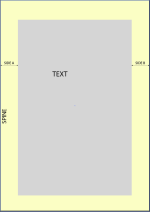
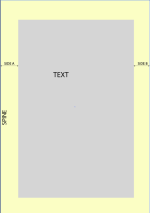
This is why we need Creep in a saddle stitched book. With CREEP side A and side B are equal, without CREEP side B is less than side A.
Attachments
ravi.thinkingant
Member
Just wondering how others calculate creep. We recently printed a 76 page saddle stitched booklet and the creep did not produce what I would consider a great result even with the scaling feature. As a Preps user I use what Kodak suggests, total pages divided by 4 times paper thickness. In this case we printed on 70# coated text, just wondering what number others would use. I came up with .0665 and ended up almost doubling it to .1 but like I said it was less than perfect. Thanks.
Hi, creep will be max. on the center pages and it will reduce to 0 on page 1,2 and second last, last page. To calculate creep minus 4 pages (first 2 and last 2) from total page count, then divide by 4,, multiply by paper thickness. In your job, 76-4=72/4=18*0.0035 = .063in should be the creep compensation in the innermost pages - 38 and 39.Just wondering how others calculate creep. We recently printed a 76 page saddle stitched booklet and the creep did not produce what I would consider a great result even with the scaling feature. As a Preps user I use what Kodak suggests, total pages divided by 4 times paper thickness. In this case we printed on 70# coated text, just wondering what number others would use. I came up with .0665 and ended up almost doubling it to .1 but like I said it was less than perfect. Thanks.
The creep will go on reducing as you move back to starting and end pages. In below image page 35 has 0.0595in creep.
The creep can change if your folding machine has wear and tear, with folds not sharp. In that case you need to add compensantion factor.
We use InSoft Automation's Imp software with controls to define creep as per design and by moving or scaling content. It also offers settings to enter compensation factor.
Hope this helps.
Ravi
Similar threads

- Replies
- 10
- Views
- 1K
- Replies
- 5
- Views
- 1K
- Replies
- 11
- Views
- 1K
- Replies
- 9
- Views
- 1K