

noelward
Well-known member
When Close Enough is not Enough
By Noel Ward, Editor@Large
Your pickiest customer insists the color throughout his new 12-page brochure and assorted collateral match the color of the pristine vintage Ferrari he just inherited from his uncle. Known as “Rosso Corsa” or Racing Red, the unique hue goes back over half a century. Now you have to reproduce it. So you pull out your swatch books and head out to the shady spot where the always-garaged-and-covered 1966 Ferrari is parked, armed with the best color samples the print industry can provide. You note that it is a nice car.
Sometimes Close Enough is not an Option
Another approach would be using a Nix Color Sensor, a wireless, palm-sized spectrophotometer that uses Nix Print Pro software to define Rosso Corsa (or any other hue) so you can reproduce the color accurately. Being a wireless kind of guy who is ever skeptical about color, I perused the Nix Sensor website. According to the site, the sensor hooks up with proprietary software to tell you what you are working with. This could be a valuable tool when you are faced with new colors or ones that don’t quite match the swatches or the color sensitivity of your art director or press operator. I liked that it was designed for our digital age. Its sensor can be linked to an Android or iOS device which might make it a popular option for sheet-offset printers who like to do a sanity check on unfamiliar colors.
A common practice these days involves a measuring device wired to a computer. This seems awkward, just as toting swatches while trying to match colors seems a practice of the last century—which it is. I liked the portable and wireless approach but would Nix be an answer?
Okay, you probably don’t have to match the paint of classic Ferraris very often. But you possibly have projects where your skill as a printer requires matching a certain color or providing truly complimentary hues for fashion, corporate palettes, furniture, or home décor. While close enough will often get the job done, offering spot-on colors can separate you from the competition. Pleasing color is fine but there are instances when a color must be exact. The Nix Sensor helps you do this.
Color can be a strange critter
While portions of the world think pleasing color—whatever that may be—is fine, there are times when a color must be absolutely accurate. Branding and corporate colors come to mind. While there may be some latitude for variance in these hues, brand owners and product managers can sometimes be a little insistent on a certain color. Too often you may have to match a brand color using CMYK. Of course, this is not always possible because of CMYK’s smaller color gamut and the variability of the printing process. Hues such as metallics, neons, and deep oranges come to mind. While a close approximation can sometimes be made, an exact match is not always achievable. Manually adjusting CMYK percentages on press may also provide an approximation for colors close to the CMYK range. Similarly, if you can do so on your press, upping your CMYK gamut to seven colors (adding orange, green and violet) may let you reproduce a larger percentage of PMS colors.
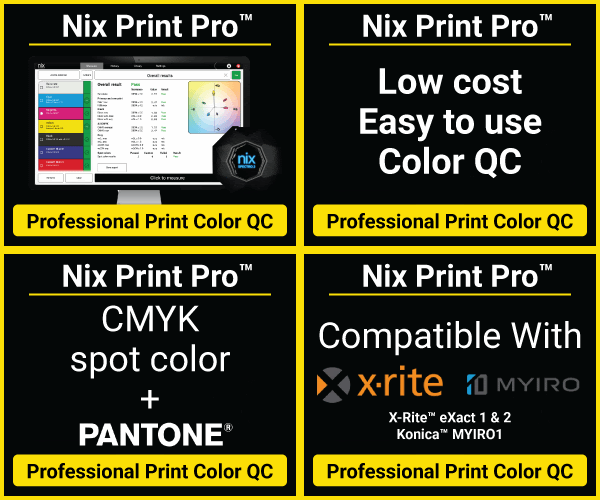
Understanding these challenges, Nix has modules for different requirements and applications, such as one for PMS colors. An assortment of optional software modules is available so users can build a system that works for their needs. Talk with Nix Sensor for more details.
Now suppose the color is one like that 1966 Ferrari or the complimentary colors in the brochure for the custom-stained wood in a high-dollar condo complex. The portability of the Nix sensor lets you go on site, measure the color needed and formulate ink for your press faster and more accurately than your pressman or graphic designer. The sensor reads the color and can tell you what you need to know when creating ink colors or buying what you need. This lets you spend more time being billable, like printing jobs.
The Nix Sensor and its software have won awards in Germany and here in the U.S. While some software magic going on, what first struck me is the stick-it-in-a-pocket practicality and portability (the sensor actually travels in a padded case). This lets you take it to the object being measured and use it live and in person: in your parking lot, inside a fancy home or a client’s factory. You take your measurement, connect the sensor to a computer via Bluetooth and see what you need to know. I haven’t had to measure color in person for a long time but this would seem to be an advantage. Check it out at nixsensor.com.
By Noel Ward, Editor@Large
Your pickiest customer insists the color throughout his new 12-page brochure and assorted collateral match the color of the pristine vintage Ferrari he just inherited from his uncle. Known as “Rosso Corsa” or Racing Red, the unique hue goes back over half a century. Now you have to reproduce it. So you pull out your swatch books and head out to the shady spot where the always-garaged-and-covered 1966 Ferrari is parked, armed with the best color samples the print industry can provide. You note that it is a nice car.
Sometimes Close Enough is not an Option
Another approach would be using a Nix Color Sensor, a wireless, palm-sized spectrophotometer that uses Nix Print Pro software to define Rosso Corsa (or any other hue) so you can reproduce the color accurately. Being a wireless kind of guy who is ever skeptical about color, I perused the Nix Sensor website. According to the site, the sensor hooks up with proprietary software to tell you what you are working with. This could be a valuable tool when you are faced with new colors or ones that don’t quite match the swatches or the color sensitivity of your art director or press operator. I liked that it was designed for our digital age. Its sensor can be linked to an Android or iOS device which might make it a popular option for sheet-offset printers who like to do a sanity check on unfamiliar colors.
A common practice these days involves a measuring device wired to a computer. This seems awkward, just as toting swatches while trying to match colors seems a practice of the last century—which it is. I liked the portable and wireless approach but would Nix be an answer?
Okay, you probably don’t have to match the paint of classic Ferraris very often. But you possibly have projects where your skill as a printer requires matching a certain color or providing truly complimentary hues for fashion, corporate palettes, furniture, or home décor. While close enough will often get the job done, offering spot-on colors can separate you from the competition. Pleasing color is fine but there are instances when a color must be exact. The Nix Sensor helps you do this.
Color can be a strange critter
While portions of the world think pleasing color—whatever that may be—is fine, there are times when a color must be absolutely accurate. Branding and corporate colors come to mind. While there may be some latitude for variance in these hues, brand owners and product managers can sometimes be a little insistent on a certain color. Too often you may have to match a brand color using CMYK. Of course, this is not always possible because of CMYK’s smaller color gamut and the variability of the printing process. Hues such as metallics, neons, and deep oranges come to mind. While a close approximation can sometimes be made, an exact match is not always achievable. Manually adjusting CMYK percentages on press may also provide an approximation for colors close to the CMYK range. Similarly, if you can do so on your press, upping your CMYK gamut to seven colors (adding orange, green and violet) may let you reproduce a larger percentage of PMS colors.
Understanding these challenges, Nix has modules for different requirements and applications, such as one for PMS colors. An assortment of optional software modules is available so users can build a system that works for their needs. Talk with Nix Sensor for more details.
Now suppose the color is one like that 1966 Ferrari or the complimentary colors in the brochure for the custom-stained wood in a high-dollar condo complex. The portability of the Nix sensor lets you go on site, measure the color needed and formulate ink for your press faster and more accurately than your pressman or graphic designer. The sensor reads the color and can tell you what you need to know when creating ink colors or buying what you need. This lets you spend more time being billable, like printing jobs.
The Nix Sensor and its software have won awards in Germany and here in the U.S. While some software magic going on, what first struck me is the stick-it-in-a-pocket practicality and portability (the sensor actually travels in a padded case). This lets you take it to the object being measured and use it live and in person: in your parking lot, inside a fancy home or a client’s factory. You take your measurement, connect the sensor to a computer via Bluetooth and see what you need to know. I haven’t had to measure color in person for a long time but this would seem to be an advantage. Check it out at nixsensor.com.