
You are using an out of date browser. It may not display this or other websites correctly.
You should upgrade or use an alternative browser.
You should upgrade or use an alternative browser.
Kodak Maxtone SX on offset press
- Thread starter Alien
- Start date
Probably smooth and seamless transition from fm to am structureWhy SX rather than CX?

gordo
Well-known member
SX has a more gradual transition from AM to FM than FX does - however, SX may exhibit graininess in highlight/pastel areas since they cover a larger tone area with basically a first order FM screening. CX on the other hand keeps the dots on the AM grid (dots of specified minimum/maximum size are removed in an FM manner).
Again, why are you considering this class of screening? Is there a press problem you’re having?
Again, why are you considering this class of screening? Is there a press problem you’re having?
Last edited:

Alien
Well-known member
One of our large customers wants to print with a hybrid screening.Why are you considering this screening? Is there a press problem you’re having? Why SX rather than CX?
He does not like Stoccato screening.
As far as I remember from the presentation at GUA, this Maxton SX is a more modern way of screening and provides a smooth transition from FM to AM in highlights and from AM to FM in shadows.
Perhaps I misunderstood the presentation, but the dealer and the Kodak itself have little to no information about successful implementations of Maxton SX and CX.
What exact problems on press are you reffering to?
Last edited:
gordo
Well-known member
One of our large customers wants to print with a hybrid screening.
He does not like stochastics.
As far as I remember from the presentation at GUA, this Maxton SX is a more modern way of screening and provides a smooth transition from FM to AM in highlights and from AM to FM in shadows.
Perhaps I misunderstood the presentation, but the dealer and the Kodak itself have little to no information about successful implementations of Maxton SX and CX.
What exact problems on press are you reffering to?
Note - I was on the original creo/Kodak screening solutions development team. I do not work for Kodak.
Maxtone is the name of Kodak's AM screening system.
The variants Maxtone CX, Maxtone FX, and Maxtone SX were originally developed for flexo printing. Traditional flexo plates have limitations in the minimum dot size that they can hold. The result is a harsh tone break in the highlights and shadows. CX, FX, and SX are conventional AM (Maxtone) screens that were designed to overcome that inability of flexo plates to hold small dots. They do this by constraining the highlight and shadow dots to the minimum dot size the imaging system can reliably hold. To render areas of tone lighter or darker than the system can image, dots of the minimum imageable size are removed - fewer dots - rather than making them smaller - results in lighter tone areas. CX, FX, and SX are variations on how that is accomplished as well as what happens to the remaining dots.
Effectively the halftone screen is compromised in order to overcome resolution limitations of the (flexo) imaging system.
CX, FX, and SX are NOT a "more modern way of screening". They are technologies designed to overcome imaging resolution limitations. As a result, every vendor that is involved in flexo offers a comparable work around. One way that vendors of this class of screening distinguish their offerings from their competition is how much control printers have to modify the screens as well as how well they handle the transition from the conventional AM part of the tone scale to the minimum dot size part of the tone scale.
CX, FX, and SX should not be needed in an offset environment since the plates, laser imaging, and press normally do not have the resolution limitations of flexo. If you have an offset plating/press which cannot maintain halftone dot sizes smaller than, for example, a 5% tone then you need to solve that problem rather than compromise your printing with a hybrid screen.
Your dealer and Kodak may not have any implementation information to give you simply because this class of screening is not usually needed in an offset environment. They may have examples for a flexo environment - but that experience wouldn't be of any value to you or your customer.
Your customer is misinformed about screening (including "stochastic").
Last edited:
gordo
Well-known member
Thank you for quick response.
The point is that customer wants high LPI AM-screning (300 lpi and higher) and specifically don't want Staccato screening (which we have (20 u) and regulary use).
We use Kodak Magnus VLF (with Square Spot) and Sonora X plate.
I’ve imaged 10 micron Staccato on the Magnus VLF - so you should be good there.
Kodak’s specification for the Sonora plate is 1% to 99% @ 200 lpi with 450 lpi possible. So you should be good to go there.
IMHO you should just crank your existing screen to 300 lpi and not bother with CX or SX.
Run a test on an off cut if you’re really worried.
gordo
Well-known member
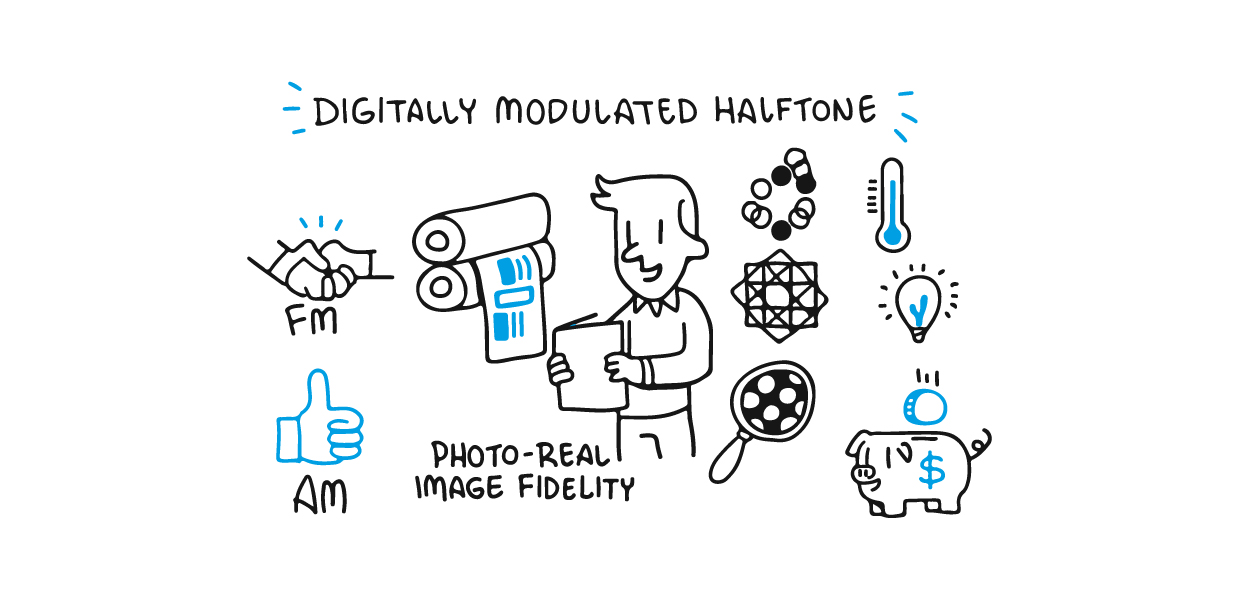
This DMS (Digitally Modulated Screening) sounds something like what your customer may be referring to as it’s basically a hybrid combination of both AM and FM screening together. It’s called Auraia and if you check the website, you’ll see that it can be used in almost all CtP imagesetters, and with most plate types, as well.
Something I thought was especially interesting is what they’re calling a ‘stochastic rosette’.
Auraia Digitally Modulated Screening DMS - Hamillroad Software Limited
Auraia DMS dramatically enhances quality, stability, and gamut, while delivering ink savings over conventional screening for offset / litho printing.www.hamillroad.com
Auraia DMS is not a hybrid screen in the sense that the OP’s customer is likely thinking of. Many millions of magazine pages are printed every month in the US using Auraia so you can judge the quality for yourself at any newsagent. The “digital rosette “ refers to how the dots interleave and has nothing to do with a conventional halftone screen’s rosette.

DeltaE
Well-known member
@gordo
It might be not related to this topic, and I have question about process control, especially in prepress when I make plates with very high resolution (more than 300 lpi with AM, or 10 micron with FM). What do you think about the acceptable tolerance for plate dot area in 1%, 25%, 50% and 75% area? What the number should be?
In my printshop, we print sometimes with screening Maxtone AM 300 Lpi in some jobs, but the tolerance for plate process control is a question that I need your advice. What is the good number based on your experience?
Thanks and regards,
Delta E
It might be not related to this topic, and I have question about process control, especially in prepress when I make plates with very high resolution (more than 300 lpi with AM, or 10 micron with FM). What do you think about the acceptable tolerance for plate dot area in 1%, 25%, 50% and 75% area? What the number should be?
In my printshop, we print sometimes with screening Maxtone AM 300 Lpi in some jobs, but the tolerance for plate process control is a question that I need your advice. What is the good number based on your experience?
Thanks and regards,
Delta E
gordo
Well-known member
@gordo
It might be not related to this topic, and I have question about process control, especially in prepress when I make plates with very high resolution (more than 300 lpi with AM, or 10 micron with FM). What do you think about the acceptable tolerance for plate dot area in 1%, 25%, 50% and 75% area? What the number should be?
In my printshop, we print sometimes with screening Maxtone AM 300 Lpi in some jobs, but the tolerance for plate process control is a question that I need your advice. What is the good number based on your experience?
Thanks and regards,
Delta E
If memory serves - the accepted standard is +/- 2% at 50% using 175 lpi AM. Remember that Maxtone is a conventional AM screen except in the 1-4% (99-96%) range. Also keep in mind that all plate readers differ in the accuracy and consistency of their measurements.
I don’t know of any standard for higher lpi.
In any case, the important thing is that the dots are imaged consistently - whatever their tone values are. When it comes to process control, consistency is much more important than accuracy.
Similar threads
- Replies
- 7
- Views
- 1K

- Replies
- 1
- Views
- 670
- Replies
- 8
- Views
- 1K