
Not typical "Ghosting". Komori.

Tomas

Member
Hello!
Has anyone encountered this?
Komori L40. UV LED ink. On different sections and inks.
A ghostly imprint of a dark 100% element appears at 314 mm along the sheet on the raster area
of another section of the design. Apparently, the paint on the plate is removing some of the ink from the "V" roller.
314 mm is exactly the 100 mm diameter of this roller.
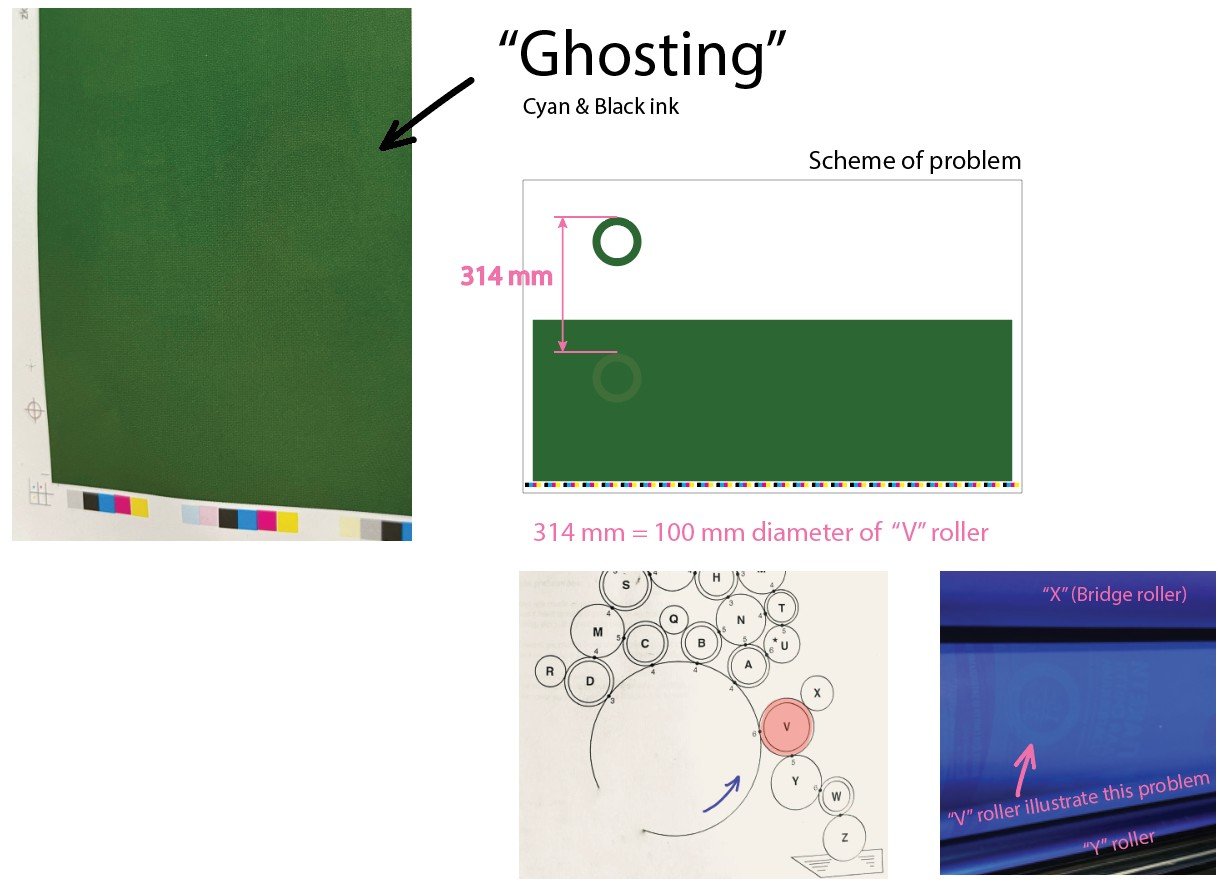


Ghosting_Need Help.jpg


Tried:
More water and ink
Less water and ink
Reducer paste
Different fountain solution formulations

Help
 
Tomas, this question is very similar to others you have posted in the past.
I suggest you use the same posts for the same problems, instead of creating a new post.
I think you are from Slovenia (east of Italy).
A better term then "paint" is "ink".

Is the "X" roller really a "Bridge" roller or just a rider roller?
Have you tried engaging on and disengaging off this roller?
In your photo of the "V" roller, is that roller inked (cyan) or uninked?
How much oscillation (sideways) stroke are you using on your vibrators?
Have you ever tried "Anti-ghosting" ink form rollers?
What does a single pull of just cyan and just black look like?
If you flip blanket 180', does it remain in same location or does it move with blanket. Trying to rule out it's not a after image from an embossed blanket. UV inks require EPDM rollers and blankets too!
 
Tomas, this question is very similar to others you have posted in the past.
You are absolutely right - this post is the reason why I still haven't found a solution to my problem.
Here I decided to ask the question a little differently.
Please forgive me for repeating myself. If this violates the rules, I can move the question to an older thread.

On the topic of the problem:
I'm more inclined to believe it's a chemical reaction between the paint and water (the composition of the dampening solution).
I don't think emulsification is occurring properly.
The separation of the water and oil phases is so severe that no amount of rubbing can even out the paint.
As a result of this chemical reaction, the paint adheres to itself like glue in 100% of the areas on the plate, pulling the paint off the dampening roller "V."

My other guess is that the paint is overcooled by water.
The water in the tanker is 11-12 degrees Celsius
Tempering and coloring rollers are about 24-25 degrees Celsius during operation.
It is possible that the rheology is disrupted due to the paint not being heated enough and it sticks to itself on the plate.
 
Some information about the parameters when the defect appeared:

1. Moisturizing solution:
Water = 13 dH
Isopropanol = 5%
Buffer additive = 1.2%
11-12 degrees Celsius

2. The defect occurs exclusively through the moistening knurling roller "V".
Its diameter is 100 mm, which is equal to 314 mm for the ghostly image that is duplicated.
The bridge roller constantly rolls along it in oscillation mode, but this does not help in any way.
Switching the bridge roller to different modes does not produce any result.

3. This drawing is not a print of an image from a blanket - verified.
And not a suction cup mark on the feed.

4. The paint does not receive any partial exposure from window light or intermediate UV lamps (they simply do not exist).
 
Silly question -
What is your color unit sequence?
Does the defect persist when you change color unit sequence?
 
When reading your post, I still get distracted by your use of the word "paint" while you also intermittently use the word "ink". If English is not your native language, please use the correct term.
Are you the actual press operator or a supervisor/manager?
If not the operator, what do they think?
What does your ink, fountain solution and roller vendor/supplier think?
If and when a permanent solution is found, please post that for others to learn.
Good Luck
 
   
Back
Top