


gordo
Well-known member
Look at any modern presswork under a loupe and you'll see those ubiquitous halftone dots. Even inkjet presses use dots to create the final image.
However, there is a printing process that eliminates halftone screening completely and renders true continuous tone lithography.
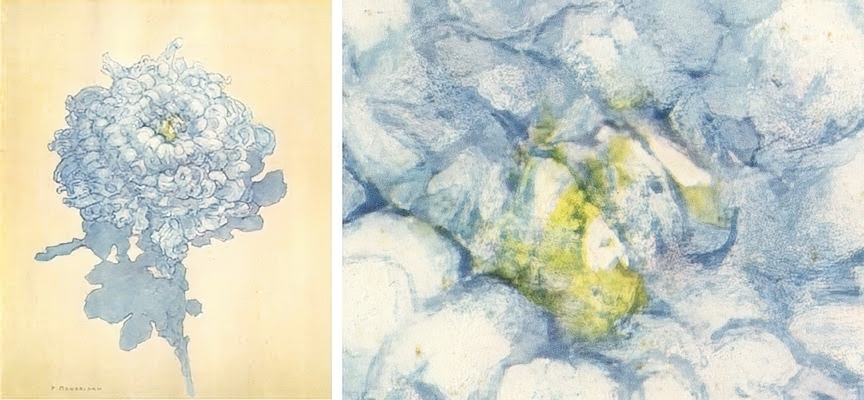
On the left is a full image of a 12" x 18" reproduction of a Mondrian painting. On the right is a close-up of just the center of the image. No halftone dots!
Collotype (a.k.a. photo-gelatin, heliotype, albertype, litchdruck, phototypie process)
Collotype is a photographic method of producing a lithographic printing surface in gelatin in which tones can be reproduced without the use of any halftone screen. This reproduction method was devised about 1860 by a Mr. Poitevin and introduced commercially in 1867 under the name "phototypie" by du Motay and Maréchal.
Although it initially became a widely used process, it was very difficult to control and not suited for long press runs. As a result, it was replaced by conventional offset lithography (with its halftone screening) and became a specialized process that was mostly used for fine art reproductions. Today, there are only a very few printers using this process (e.g. Black Box Collotype Ltd in the U.S. and Benrido in Japan).
Collotype printing
The collotype plate is made by coating a plate of glass, or sometimes metal, with a substrate composed of gelatin or other colloid and hardening it. Then it is coated with a thick coat of bichromated gelatin and dried carefully at a controlled temperature (a little over 50° C waters) so it 'reticulates' or breaks up into a finely grained pattern when washed later in approximately 16° C water. The plate is then exposed in contact with the negative using an ultraviolet (UV) light source which changes the ability of the exposed gelatine to later absorb water. The plate is developed by carefully washing out the bichromate salt and dried without heat. The plate is left in a cool dry place to cure for 24 hours before using it to print.
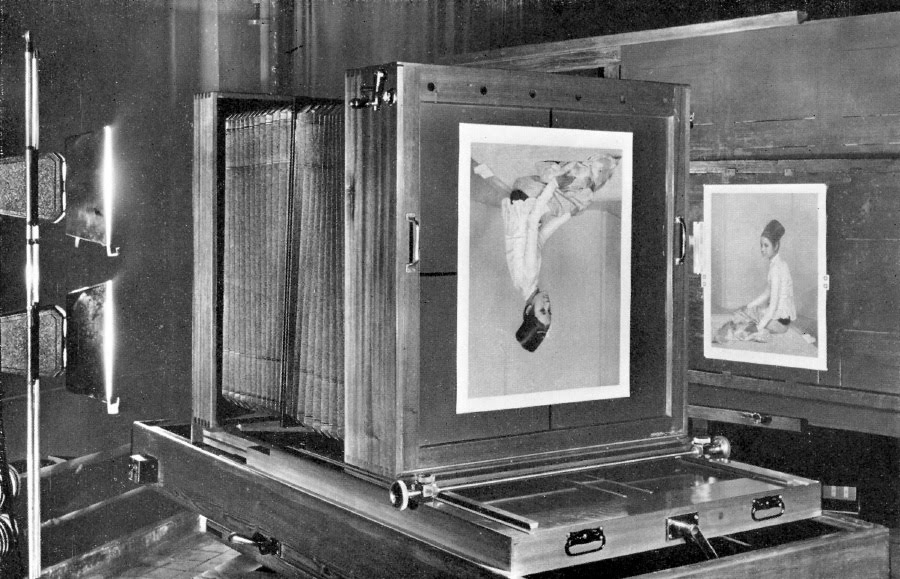
Exposing the film negative This view is of the back of the camera which is set at a right angle to the original art.

An artist/retoucher works on the film negative to make adjustments to the tones of the negative so that they will create a plate that accurately reproduces the original art. With a full color reproduction, all four, or more, negatives will have to be corrected.

The glass plate being exposed.

A photo-electric cell is used to test the tone and color density.
To produce prints, the plate is dampened with a glycerine/water mixture which is slightly acidic , then blotted before inking with Collotype ink using a leather or velvet roller. A hard finished paper such as Bristol, is then put on top of the plate and covered with a tympan before being printed typically using a manual proof press.


Two views of a Collotype press.
The result is a reproduction that is indistinguishable from a photographic print.

Full image and magnified to show the detail.
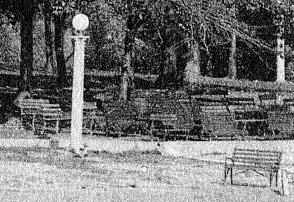
The closest modern equivalent to producing continuous tone lithographic printing is 10 micron FM screening which, even under 10x magnification, appears to not have been halftone screened as in the example below:
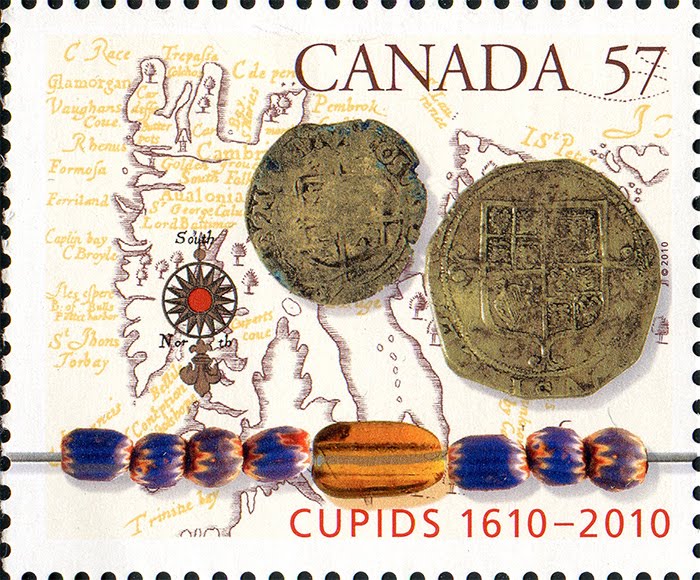


Canadian postage stamps are an excellent example of 10 micron FM screening that results in presswork with a similar image fidelity to Collotype printing.
However, there is a printing process that eliminates halftone screening completely and renders true continuous tone lithography.
On the left is a full image of a 12" x 18" reproduction of a Mondrian painting. On the right is a close-up of just the center of the image. No halftone dots!
Collotype (a.k.a. photo-gelatin, heliotype, albertype, litchdruck, phototypie process)
Collotype is a photographic method of producing a lithographic printing surface in gelatin in which tones can be reproduced without the use of any halftone screen. This reproduction method was devised about 1860 by a Mr. Poitevin and introduced commercially in 1867 under the name "phototypie" by du Motay and Maréchal.
Although it initially became a widely used process, it was very difficult to control and not suited for long press runs. As a result, it was replaced by conventional offset lithography (with its halftone screening) and became a specialized process that was mostly used for fine art reproductions. Today, there are only a very few printers using this process (e.g. Black Box Collotype Ltd in the U.S. and Benrido in Japan).
Collotype printing
The collotype plate is made by coating a plate of glass, or sometimes metal, with a substrate composed of gelatin or other colloid and hardening it. Then it is coated with a thick coat of bichromated gelatin and dried carefully at a controlled temperature (a little over 50° C waters) so it 'reticulates' or breaks up into a finely grained pattern when washed later in approximately 16° C water. The plate is then exposed in contact with the negative using an ultraviolet (UV) light source which changes the ability of the exposed gelatine to later absorb water. The plate is developed by carefully washing out the bichromate salt and dried without heat. The plate is left in a cool dry place to cure for 24 hours before using it to print.
Exposing the film negative This view is of the back of the camera which is set at a right angle to the original art.
An artist/retoucher works on the film negative to make adjustments to the tones of the negative so that they will create a plate that accurately reproduces the original art. With a full color reproduction, all four, or more, negatives will have to be corrected.
The glass plate being exposed.
A photo-electric cell is used to test the tone and color density.
To produce prints, the plate is dampened with a glycerine/water mixture which is slightly acidic , then blotted before inking with Collotype ink using a leather or velvet roller. A hard finished paper such as Bristol, is then put on top of the plate and covered with a tympan before being printed typically using a manual proof press.
Two views of a Collotype press.
The result is a reproduction that is indistinguishable from a photographic print.
Full image and magnified to show the detail.
The closest modern equivalent to producing continuous tone lithographic printing is 10 micron FM screening which, even under 10x magnification, appears to not have been halftone screened as in the example below:
Canadian postage stamps are an excellent example of 10 micron FM screening that results in presswork with a similar image fidelity to Collotype printing.