Tariffs - Have they, or, will they impact your business?

gordo

Well-known member
A total of 246 companies responded to a survey conducted by Printing United Alliance inMarch 2025. The majority are commercial printers, graphic and sign (wide-format) printers, or apparel decorators.

Some of their responses below - do you agree or not?

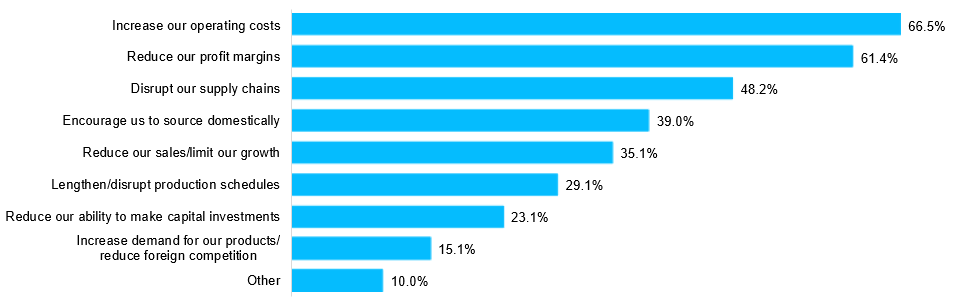
RE: How are (or do you expect) higher tariffs to affect your business?
How are (or do you expect) higher tariffs to affect your business?.png


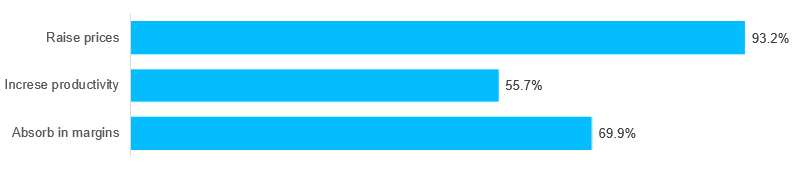
RE: How will you respond to the increase in tariffs?
How will you respond to the increase in tariffs?.png

Source: The Effects of Tariffs on the Printing Industry Survey, PRINTING United Alliance, March 2025
 
With tariffs causing economic contraction and economic instability, I expect financing will be even more expensive and/or difficult to obtain.
 
I remember a couple of years ago, everyone had issues getting toner and consumables because they were stuck in containers on cargo ships offshore. Therefore, I'm assuming they are imported from other countries. I wonder what effect that will have on already contracted click charges. Will the OEM's just eat the loss, or, will they figure out how to pass that increase on to the users?
 
I remember a couple of years ago, everyone had issues getting toner and consumables because they were stuck in containers on cargo ships offshore. Therefore, I'm assuming they are imported from other countries. I wonder what effect that will have on already contracted click charges. Will the OEM's just eat the loss, or, will they figure out how to pass that increase on to the users?
This brings up an interesting question, if it takes 30 to 45 days for products to be shipped from China then why would we expect to see price increases right away. Mexico and Canada I can see but not from any other country that ships via sea vessels. Some Canadian companies have already moved products across the border and are storing it to avoid at least the short term impact.

The toner that I receive from Xerox is all made in Rochester New York, but the drums come from Mexico. I'm sure some of the raw materials for the toner get imported.
 
I wonder if any of you have had strategy meetings about this with your respective companies?

Will you put off needed purchases because of an uncertain financial future?

Pull the trigger now and purchase what you think you will need before the tariffs kick in?

For those of you in the US that make money by performing print and mail, how will privatizing the USPS affect your business (if they go that way).

Will there be any new printing opportunities (like reprinting resort collateral for resorts located on the Gulf of Mexico/Gulf of America)?
 
Last edited:
If he implements tariff’s on European Union countries as I’ve been hearing, my plate, paper, and proofing media costs may go up :-(
 
We may not see increase in prices. We may see decreases.

Trump’s plan has always been to just get everyone to drop their tariffs against us, to get to a true free trade situation with no subsidy of others by America.

Vietnam, India, Israel have all dropped their tariffs against us and possible Canada. More will do that once actual tariffs go into effect but not before, which is why we must actually implement them for real (not just the threat of).

Things are working out just as Trump planned, while the media around the world tries to scare everyone.
 
We may not see increase in prices. We may see decreases.

Trump’s plan has always been to just get everyone to drop their tariffs against us, to get to a true free trade situation with no subsidy of others by America.

Vietnam, India, Israel have all dropped their tariffs against us and possible Canada. More will do that once actual tariffs go into effect but not before, which is why we must actually implement them for real (not just the threat of).

Things are working out just as Trump planned, while the media around the world tries to scare everyone.
I don’t see how what you are saying aligns with what Trump says and is doing.
 
I don’t see how what you are saying aligns with what Trump says and is doing.
Every other country in the world has tariffs against the United States. So if American manufacturers (example: Printing) want to sell printing to Europe or other countries they charge us tariffs. The goal is to discouraging Americas from competing against their manufacturers for "in-country" buyers. India wants to sell to the USA but does not want the USA to sell to India because they want Indians to buy from other Indian manufacturers.
Trump has stated that our tariffs against them will simply be a match of what their tariffs are against us.

Example:
If India charging a 25% tariff against "printed goods" being sold from USA->India. Then America will charge a tariffs matching tariffs India->USA. Since India sells more printed goods into the USA than the opposite India has no real motive to not simply drop their tariffs.

By doing a "matching tariff" eventually you will end up with Free Trade between the countries.
 
We may not see increase in prices. We may see decreases.

Trump’s plan has always been to just get everyone to drop their tariffs against us, to get to a true free trade situation with no subsidy of others by America.

Vietnam, India, Israel have all dropped their tariffs against us and possible Canada. More will do that once actual tariffs go into effect but not before, which is why we must actually implement them for real (not just the threat of).

Things are working out just as Trump planned, while the media around the world tries to scare everyone.
The words that aren't being said:

The United States needs a drastic revitalization of manufacturing talent and knowledge. Unfortunately, in order to get these jobs stateside, we need to rip off a few band-aids. Some of that are these reciprocal tariffs. While this may produce a bit of pain, the improvement of manufacturing knowledge for millenials and zoomers is necessary to keep the US relevant, especially as technology like Tesla's Optimus becomes ubiquitous throughout the world. It will be rather trivial in 10 years to produce a humanoid robot, while right now it is seen as nigh impossible (but there are many companies working on this, and making great headway). So, with the cheapest available labor, manufacturing should become hyperlocal, thus if we don't know how to do certain things here in the US, it will have drastic consequences as the robots (non-US made) will fill in and supplement existing manufacturing facilities abroad. Tesla will be making millions upon millions of humanoid robots before 2030. This is a certainty, not a possibility. This is a good thing for the US, so the next time some retard tells you Tesla is bad, do yourself a favor and find out which company makes the cars with the most US-sourced parts. The same will be true for their Optimus robots. They will be a HUGE competitive advantage for the United States.

Regarding price decreases:

If energy prices fall dramatically, which they likely will, that will bring down prices in a big way. The cost to transport something is large portion of the bottomline cost.

Also, I think we're about to see the USD rally extremely hard versus other local currencies, and the death of most fiat currencies. The US is a gigantic consumer economy, and producer countries often employ a strategy of weakening their own currency to ensure their producers stay competitive vs other producer countries in the market of selling products to our consumer economy. That's obviously a complicated thing to explain, but this tariff action starts to make all of them much less competitive than they have been, and incentivizes US-based production. If a country starts to export substantially less than they were previously...

Overall, this needed to be done. Yes, there will be consequences, but we will find out a way to navigate things, just like we did during COVID when paper mills started converting to board manufacturing.

 
I think this is mostly because you have Canadian-colored glasses.
I don't know if it's specifically "Canadian" vs. that in many countries the "source" of news is almost exclusively CNN or state controlled. At least that was what I heard from my sibling when she lived abroad. The only news source in each of the four countries she lived in when she was teaching internationally was CNN or state controlled. There is still an entire generation that gets the majority of it's news source from sources they consider to be independent (because they were independent 20 years ago).

In my opinion there is now a clear bias (which is acceptable) as long as they don't claim to be un-bias. I get my news from multiple different "bias" sources and then try to piece together what I consider to be a fair approximation of everyone's opinions and then form my own opinion based off of that.
 
I don't know if it's specifically "Canadian" vs. that in many countries the "source" of news is almost exclusively CNN or state controlled. At least that was what I heard from my sibling when she lived abroad. The only news source in each of the four countries she lived in when she was teaching internationally was CNN or state controlled. There is still an entire generation that gets the majority of it's news source from sources they consider to be independent (because they were independent 20 years ago).

In my opinion there is now a clear bias (which is acceptable) as long as they don't claim to be un-bias. I get my news from multiple different "bias" sources and then try to piece together what I consider to be a fair approximation of everyone's opinions and then form my own opinion based off of that.
Televisions are just mass psychosis devices. If you still own one...

I'm not joking. If you own a television, do yourself a favor and fucking throw it away. The amount of idiotic television dribble that comes out of the mouths of those affected is baffling. Please, save yourself and your family.
 
Regarding price decreases:

If energy prices fall dramatically, which they likely will, that will bring down prices in a big way. The cost to transport something is large portion of the bottomline cost.
I would like to believe this, as lower prices obviously should help those who are struggling. What, if any, benchmarks are there for us to see easily enough if prices are dropping? I’m thinking more of the price of specific grocery items because that’s something that a lot of people feel are too expensive now. It would be interesting to see where these prices are weeks/months/years from now.
 
I would like to believe this, as lower prices obviously should help those who are struggling. What, if any, benchmarks are there for us to see easily enough if prices are dropping? I’m thinking more of the price of specific grocery items because that’s something that a lot of people feel are too expensive now. It would be interesting to see where these prices are weeks/months/years from now.
I think there's a group that tracks the average annual cost of a traditional thanksgiving dinner?
 
I would like to believe this, as lower prices obviously should help those who are struggling. What, if any, benchmarks are there for us to see easily enough if prices are dropping? I’m thinking more of the price of specific grocery items because that’s something that a lot of people feel are too expensive now. It would be interesting to see where these prices are weeks/months/years from now.
Start denominating things in real money, like gold, or a diversified basket of assets. The USD may appreciate versus other local currencies, but versus hard assets? S&P500 chart vs gold is down only.
 
   
Back
Top