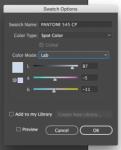
Someone today told me that PANTONE guides are different worldwide.
I mean, the colors printed have different LAB values, because the inks are different!
Are we sure? Or it's a metro legend?
I know process inks are different from US to EU, but this is another story.
No. It is not true.
The one unchanging constant in Pantone colors is the ink formulations themselves. Get any formula book, on any stock, from anywhere in the world, and compare the ink formulations, and they'll always be the same.
That's what Pantone colors originally were/are: Ink formulas. Mix up the component colors in the requisite amounts, and you've got yourself some Pantone Whatever. And it's Pantone Whatever, and that's its ink formula, regardless of the media on which you print it.
L*a*b* values for those ink formulas came along relatively late in the game. What
has happened and the explanation for it I saw a few years back by someone from X-Rite on some other forum, is that around the time they -- Pantone -- came out with the Plus colors, they changed the paper stock they printed the books on, and that caused the L*a*b* values of certain colors to shift a bit.
And the shifting definitely did happen. You can run through the old PMS and PMS + libraries in any application that will show you the L*a*b* values and see for yourself.
It's also true, as Tim says, that some software vendors, for reasons known only to themselves, seem to like to alter the L*a*b* numbers supplied by Pantone just a bit.
However, what I like to keep in mind is that a L*a*b* value for a Pantone color is only going to be an absolute if you're printing on exactly the same stock as the book was printed on. I also have found for many years that the best and overall easiest and most reliably accurate way to get a quick L*a*b* value for any Pantone color is just to get it out of the picker in Photoshop. And, of course, Photoshop doesn't even give you decimals.
So what I'd kind of keep in mind as you really wade into this stuff is that final reproduction and measuring are still mechanical processes, they'll never be absolute, and they're all developed to quantify a thing -- color -- that in the end doesn't even actually exist except in every viewer's individual perception.
In the end, it's what you see, not the Delta E. Or, having been at this a long time now, I've never seen a spectrophotometer write a check to pay for a job.
Mike Adams
Correct Color