


kasra
Member
Greetings,
I'm sorry in advance if this is not the correct forum to post this question.
I needed to print a black-and-white photobook quickly, so I used an online printing service rather than preparing the entire layout in InDesign for a local print house.
I ordered one proof. The print quality was acceptable. I made minor text edits only (no changes to image files) and ordered the full batch.
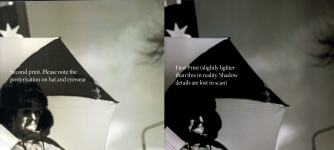
The second batch has a clear posterisation issue in the shadows. (Attachment shows proof vs final prints.)
The print provider claims this happened because parts of my images fall below RGB 10,10,10, stating:
“Abrupt transitions in dark areas can occur when subtle gradients fall past the threshold our presses can reproduce, causing dark greys to clip to pure black.”
My concerns:
Technical details:
Thanks,
Kasra
I'm sorry in advance if this is not the correct forum to post this question.
I needed to print a black-and-white photobook quickly, so I used an online printing service rather than preparing the entire layout in InDesign for a local print house.
I ordered one proof. The print quality was acceptable. I made minor text edits only (no changes to image files) and ordered the full batch.
The second batch has a clear posterisation issue in the shadows. (Attachment shows proof vs final prints.)
The print provider claims this happened because parts of my images fall below RGB 10,10,10, stating:
“Abrupt transitions in dark areas can occur when subtle gradients fall past the threshold our presses can reproduce, causing dark greys to clip to pure black.”
My concerns:
- The same images printed correctly in the first proof.
- The artefacts look like posterisation and loss of midtone transitions, not just shadow clipping.
- It also resembles tone remapping or forced brightening that exposes retouching artefacts.
- Is their explanation (shadows below RGB 10 causing this issue) technically valid, given the results?
- Based on the samples, does this look like shadow clipping, poor tone mapping, digital press posterisation, or something else?
Technical details:
- No ICC profile provided by the printer. RGB only uploads (no CMYK).
- Files are sRGB, 16-bit TIFF, high resolution.
- Test prints on my photo inkjet look clean.
Thanks,
Kasra