

You are using an out of date browser. It may not display this or other websites correctly.
You should upgrade or use an alternative browser.
You should upgrade or use an alternative browser.
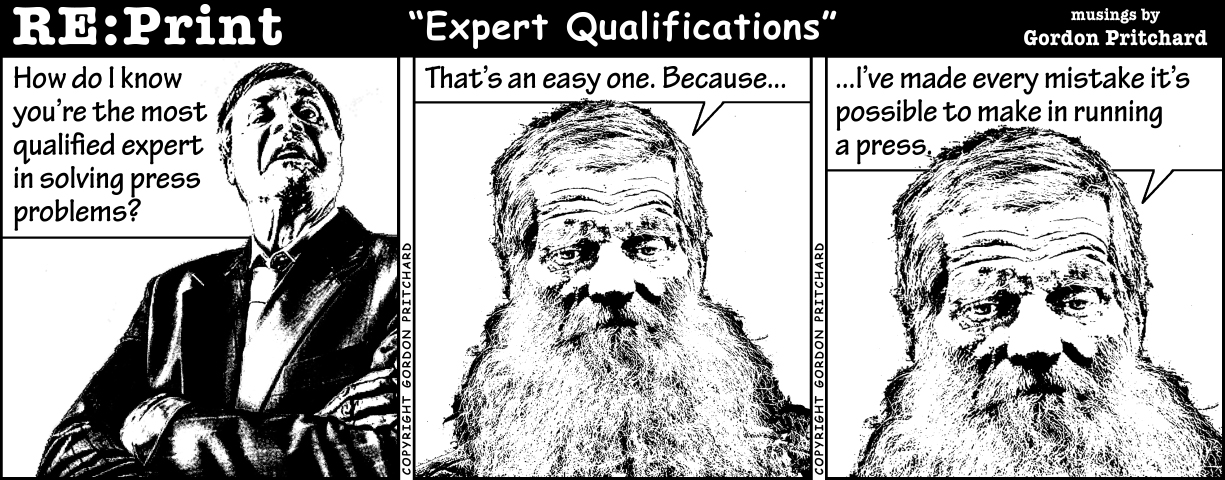
Expert Qualifications
- Thread starter gordo
- Start date

Alois Senefelder
Well-known member
Well what can I say .............
"Everything is simple - if you're simple"
Regards, Alois
"Everything is simple - if you're simple"
Regards, Alois

gordo
Well-known member
"....I think that maybe just before this meeting, one of my contacts popped out into my beard ..... could you help me find it real quick?"
When I was at creo I, as well as others in my age condition, was referred to as a “greybeard” i.e. an old guy with lots of knowledge that may or may not be valid. LOL
D
Deleted member 16349
Guest
When I was at creo I, as well as others in my age condition, was referred to as a “greybeard” i.e. an old guy with lots of knowledge that may or may not be valid. LOL
Hey greybeard, I mean Gordon, I am very sure at least half of your knowledge was extremely valid. Just not sure which half.

gordo
Well-known member
Hey greybeard, I mean Gordon, I am very sure at least half of your knowledge was extremely valid. Just not sure which half.
Neither do I.

MailGuru
Well-known member
Theoretically, with age, comes wisdom. I can remember, in my early twenties, when I rose the corporate ranks fairly quickly in the computer programming side of things, it was very frustrating getting anyone to listen to what I had to say. Most of what I had to say was dismissed and ignored because I was perceived to be a "wet behind the ears kid". They would routinely paint themselves in a corner by ignoring my advice. Now I'm 64 and have been in the industry over 40 years. It's amazing how others listen intently now, even though I really have nothing to say........
D
Deleted member 16349
Guest
When I was at creo I, as well as others in my age condition, was referred to as a “greybeard” i.e. an old guy with lots of knowledge that may or may not be valid. LOL
On the subject of valid knowledge, I am very serious about this issue.
After getting burned (wasting years and money) on following a path based on wrong assumptions back in the early 1990's, specifically related to ink key presetting and some other issues, I decided from that time on I would try not to accept any assumptions or existing knowledge without a very careful analysis for validity. As an engineer, one has several methods to do this.
For anyone who wants to do innovation, it is very critical to be ruthless in evaluation any information available or any concepts one thinks might be good. It is so easy to waste time and money on concepts that are based on faulty thinking. It is not only about the science but also about the ease of use and effectiveness in a production environment.
Of course if one is not doing innovation, then faulty knowledge makes no difference and that is the general situation in the printing industry.
gordo
Well-known member
On the subject of valid knowledge, I am very serious about this issue.
After getting burned (wasting years and money) on following a path based on wrong assumptions back in the early 1990's, specifically related to ink key presetting and some other issues, I decided from that time on I would try not to accept any assumptions or existing knowledge without a very careful analysis for validity. As an engineer, one has several methods to do this.
For anyone who wants to do innovation, it is very critical to be ruthless in evaluation any information available or any concepts one thinks might be good. It is so easy to waste time and money on concepts that are based on faulty thinking. It is not only about the science but also about the ease of use and effectiveness in a production environment.
Of course if one is not doing innovation, then faulty knowledge makes no difference and that is the general situation in the printing industry.
That ( "try not to accept any assumptions or existing knowledge without a very careful analysis for validity" ) was one of the first revelations I had working with the engineers at creo. Since they weren't knowledgeable about printing at the time I was hired (one of the reasons I was hired was to fill that gap) they questioned, and tested to validate, everything about the process. Information they got from books, technical seminars, and clients was not accepted at face value but was just considered in their investigations. Somewhat analogous to you going to the doctor with a health complaint. The doc will listen to your descriptions of symptoms and speculation about the cause - but in the end, Doc will not blindly follow your recommendations as to treatment.
On several occasions at technical seminars I've given talks to printers to remind them of the process of the scientific method that they were taught during the early days of their basic education. Just following that basic line of thinking could solve many of the issues they faced daily.
Another thing that I learned from the engineers is that print production is a "deterministic" process. I.e. if you know what you're inputting, and you know how the process works, then you can determine the output. And if the output differs from the expected then you have the tools you need to determine why and make changes accordingly. It is not a "black art."
D
Deleted member 16349
Guest
Another thing that I learned from the engineers is that print production is a "deterministic" process. I.e. if you know what you're inputting, and you know how the process works, then you can determine the output. And if the output differs from the expected then you have the tools you need to determine why and make changes accordingly. It is not a "black art."
Exactly right. I have been trying to push this understanding even before my 1997 TAGA paper, where I tried to show the rational view. But still the industry thinks, with respect to the input of ink in an offset press, that the existing inconsistent ink input of ink is somehow better than a positive input of ink. Why? Probably only because the existing method has been around for so long (160+ years) that it is accepted as being the only way the process should work. One can not innovate when people can not see that there is a problem, even if they are told there is one.
Shortly the PIA will have their Continuous Improvement conference. Each year they talk about using Lean and other tools to make improvements. But each year they show they are ignorant of the causes of variation. Some how they think some lean method will compensate for their inability to think.
Alois Senefelder
Well-known member
Gentlemen and fellow Lithographers,
Being the "devil's advocate ....." I posit that the Lithographic Printing Process IS a Stochastic Model.
Deterministic Model vs Stochastic Model
1) In deterministic models, the output of the model is fully determined by the parameter values and the initial conditions.
2) Stochasstic models possess some inherent randomness. The same set of parameter values and initial conditions will lead to an ensemble of
different outputs.
Regards, Alois
Being the "devil's advocate ....." I posit that the Lithographic Printing Process IS a Stochastic Model.
Deterministic Model vs Stochastic Model
1) In deterministic models, the output of the model is fully determined by the parameter values and the initial conditions.
2) Stochasstic models possess some inherent randomness. The same set of parameter values and initial conditions will lead to an ensemble of
different outputs.
Regards, Alois
gordo
Well-known member
Gentlemen and fellow Lithographers,
Being the "devil's advocate ....." I posit that the Lithographic Printing Process IS a Stochastic Model.
Deterministic Model vs Stochastic Model
1) In deterministic models, the output of the model is fully determined by the parameter values and the initial conditions.
2) Stochasstic models possess some inherent randomness. The same set of parameter values and initial conditions will lead to an ensemble of
different outputs.
Regards, Alois
To paraphrase Henry Ford's admonition - “Whether you think you can, or you think you can't control the process - you're right.”
There are a great many variables in print manufacturing (see attached graphic). But, if you take the attitude that there is uncontrollable randomness then, yes, you can't control it. But if you take the attitude that it is a deterministic process then you can go a long way to controlling it and understand and correct the points that result in failure.
Last edited:
D
Deleted member 16349
Guest
Gentlemen and fellow Lithographers,
Being the "devil's advocate ....." I posit that the Lithographic Printing Process IS a Stochastic Model.
Deterministic Model vs Stochastic Model
1) In deterministic models, the output of the model is fully determined by the parameter values and the initial conditions.
2) Stochasstic models possess some inherent randomness. The same set of parameter values and initial conditions will lead to an ensemble of
different outputs.
Regards, Alois
What ever one thinks the process is, it still must comply with a number of scientific principles. Conservation of Mass is one of them. At a stead state condition, the output of ink must equal the input of ink on average. This is independent on the substrate, water, roller settings, etc.
So why is this simple and reliable concept based not on a theory but a principle of science so hard for the printing industry to understand and accept? It is due to ignorance or stupidity. One can be corrected while the other can't.
As I said before, if one wants to innovate, it is important to understand things. If there is no interest in innovation, it does not matter what one thinks or says.
Also models are not processes. Models might try to represent a process but if the model is not correct, it has little value. In engineering and in science, the use of models is problematic. Models tend to be too simplistic relative to the physics of the problem. Models are helpful to show how some process might perform for educational purposes, but are not always so good at accurately predicting performance.
If one wanted to develop a model for the offset printing process, most certainly it would be too simplistic and not useful. The physical issues are so numerous and difficult for modelling. But this is the great thing about the offset process. The offset process MUST follow the principle of Conservation of Mass. That means, no matter how complicated the physics is in the transport of ink to the substrate, the amount of ink output on the substrate MUST equal the amount of ink fed into the roller train on average. So one looks for the reason why the ink feed is not consistent and one finds it is a simple problem to correct.
I am not against using models. I have done many ones for specific issues but they were mainly for understanding how things worked and most would not be useful as a technical solution. They do help to direct one to what would be a potential solution but judgement is required and so is testing.
There is a long history of testing the printing process on commercial presses. Unfortunately, for about a 100 years, none of these tests are tests of the science, relative to density control, because they were done on presses that did not control the ink variable. In my 1997 TAGA paper I also mentioned this problem doing tests on presses that were not positively controlling this critical variable.
To get valid knowledge, one needs to do valid testing. This has not been done to date and so far there seems to be no effort in understanding this important factor required to innovate. And it has always surprised me to see that managers in this industry see no connection between valid knowledge and competitive advantage.
Last edited by a moderator:
Alois Senefelder
Well-known member
Erik,
A Question.
Seeing you are intent in beating us into submission regarding the "Conservation of Mass" that after reading all your TAGA Papers,
why did the German Giants of Printing Press Manufacturers NOT follow your advice ? to what is a "Simlple" problem to correct, according to you.
I for one do not believe that Heidelberg AG have not looked at the Inking Transport Systems of Offset Presses.
Regards, Alois
A Question.
Seeing you are intent in beating us into submission regarding the "Conservation of Mass" that after reading all your TAGA Papers,
why did the German Giants of Printing Press Manufacturers NOT follow your advice ? to what is a "Simlple" problem to correct, according to you.
I for one do not believe that Heidelberg AG have not looked at the Inking Transport Systems of Offset Presses.
Regards, Alois
D
Deleted member 16349
Guest
Erik,
A Question.
Seeing you are intent in beating us into submission regarding the "Conservation of Mass" that after reading all your TAGA Papers,
why did the German Giants of Printing Press Manufacturers NOT follow your advice ? to what is a "Simlple" problem to correct, according to you.
I for one do not believe that Heidelberg AG have not looked at the Inking Transport Systems of Offset Presses.
Regards, Alois
Good question. I don't know. Maybe they are happy in what they have like you are.
A couple of quotes from others (philosophers/ scientists/ cant remember) come to mind.
1. Nothing fails like success. Success means that nothing has been learned.
2. There is no such thing as failure. You have learned another way that does not work.
Gordo, many of your comic strips (for want of a better term) are either very humorous or very thought provoking. As you have a copyright on them, is it possible for me to ask permission to post some of them on my FaceBook page?
Thanks.
Gerald.
1. Nothing fails like success. Success means that nothing has been learned.
2. There is no such thing as failure. You have learned another way that does not work.
Gordo, many of your comic strips (for want of a better term) are either very humorous or very thought provoking. As you have a copyright on them, is it possible for me to ask permission to post some of them on my FaceBook page?
Thanks.
Gerald.
Well as an old member of this community i just want to say you here that i was i am searching for this information where i can QandA others about education or qualification so finally i got this thread here actually i want to ask you about online education for me any recommendations ?
Last edited:

keith1
Well-known member
Theoretically, with age, comes wisdom. . . . Now I'm 64 and have been in the industry over 40 years. It's amazing how others listen intently now, even though I really have nothing to say........
I find myself in pretty much the same position. Just over 40 years experience and it's a handy little fact to toss out - and I find myself tossing it out quite frequently because it seems to impress clients into believing I know what I'm talking about.
I suppose I do know of what I speak for the most part, having spent many years in production. I now sit home, check customer files, create some, source the press work to trade shops (I've paid my dues).
The reality is, I'm behind the curve these days where technology is concerned. Sure I know the basics but I wouldn't stand a chance of operating today's equipment (presses), nor could I any longer function in a shops pre-press environment. At least not one that was up to date.
Still, I get the job done in my own way and I suppose that's what counts. Shops seem happy with my files and customers are pleased with results.
Couple similar analogies. People view you with more respect somehow when you represent yourself as the 'business owner'. It comes with a perception of knowledge & success. Crap! Guys on the shop floor have way more knowledge but to most, they're just the know little working stiffs. Why?
Along the same vein, I used to live lakeside. Here's a tip if you want to impress someone. Tell them you live on the lake. People's impression of you immediately escalates . . .oh, he must be wealthy! Well it was a nice property but we were far from wealthy. Hell, I was a printer! Just found the right property at the right time and bought it. I would slide that I lived on the lake into conversations with shallow people just to watch their persona change. It was kind of fun, kind of sad.
Side note unrelated. What is it with Ad Agencies? I've dealt with many, not by choice. Have spent the past couple weeks dealing with one. Zero knowledge but tons of attitude and ongoing harassment & anxiety. So far I've done 2 jobs for them. Both screwed up. Their fault, but has ended up costing me.
My 2 cents completed.

AP90
Well-known member
I find myself in pretty much the same position. Just over 40 years experience and it's a handy little fact to toss out - and I find myself tossing it out quite frequently because it seems to impress clients into believing I know what I'm talking about.
I suppose I do know of what I speak for the most part, having spent many years in production. I now sit home, check customer files, create some, source the press work to trade shops (I've paid my dues).
The reality is, I'm behind the curve these days where technology is concerned. Sure I know the basics but I wouldn't stand a chance of operating today's equipment (presses), nor could I any longer function in a shops pre-press environment. At least not one that was up to date.
Still, I get the job done in my own way and I suppose that's what counts. Shops seem happy with my files and customers are pleased with results.
Couple similar analogies. People view you with more respect somehow when you represent yourself as the 'business owner'. It comes with a perception of knowledge & success. Crap! Guys on the shop floor have way more knowledge but to most, they're just the know little working stiffs. Why?
Along the same vein, I used to live lakeside. Here's a tip if you want to impress someone. Tell them you live on the lake. People's impression of you immediately escalates . . .oh, he must be wealthy! Well it was a nice property but we were far from wealthy. Hell, I was a printer! Just found the right property at the right time and bought it. I would slide that I lived on the lake into conversations with shallow people just to watch their persona change. It was kind of fun, kind of sad.
Side note unrelated. What is it with Ad Agencies? I've dealt with many, not by choice. Have spent the past couple weeks dealing with one. Zero knowledge but tons of attitude and ongoing harassment & anxiety. So far I've done 2 jobs for them. Both screwed up. Their fault, but has ended up costing me.
My 2 cents completed.
Oh how I love the perception that people have about you. But some people just don't get it in life sometimes. My wife and I have been to africa twice in the last year. Were 28 and she has a good job and I am part owner of our family's printing business. But we don't make any stupid money. The only debt we have is our house. Dont have credit cards, don't borrow money on cars, etc. A friend was over the other day and we got to talking about finances. He basically said we were lucky and its not possible for most people to do what we do. We just shook our head and asked him how much their car payments were a month. 2 cars, almost $1100/month. We said you do know if you sold them and bought used vehicles that you could save so much money and do what we do. Nope, they're upside down on the vehicles so thats not possible. Also paying on the student loans. And I believe he already filed bankruptcy a few years ago. Mind you these are middle class people, not struggling people and are my age. So I LOVE perception. Remember this, it all depends on your situation as to how successful/wealthy you are. I do not consider myself wealthy, but to others we are rich. But I have friends that by any standards are rich, and they don't feel like they are. Perception is a fickle creature.

Well as an old member of this community i just want to say you here that i was in searching for this information where i can question others about education or qualification so finally i got this thread here actually i want to ask you about online education for me any recommendations ?
There's quite a bit of information on this site that's available by using the search feature & looking for "Online education".
Similar threads
- Replies
- 0
- Views
- 356
- Replies
- 2
- Views
- 460


- Replies
- 0
- Views
- 417
- Replies
- 0
- Views
- 343