


JMD Print Finishing
Member
I came across an interesting technical article about solving a common quality issue in book binding - the "bursting" or "blow-out" defect that occurs at the spine during three-knife trimming.
The Problem:
The "bursting head" phenomenon is a persistent defect in book production where the spine edge tears or bursts during the final trimming process. This affects both perfect binding and saddle-stitched products, compromising the appearance quality of finished books.
Root Causes:
The article identifies six main causes:
1. Paper grain direction - When cover paper grain runs perpendicular to the spine, it can help reduce bursting but may cause spine warping
2. Excessive side glue thickness in perfect binding - Improper machine operator settings leading to excessive side glue buildup
3. Worn or improperly adjusted grooving knives - When the grooving knife becomes dull or the gap between knife and shear block is too large, it creates rough, distorted grooves
4. Cutting knife grinding angle - Balance needed between sharpness (smaller angle) and durability (larger angle). Optimal range is typically 19°-25°
5. Environmental humidity - Low humidity, especially in winter, increases cracking. Maintaining ~60% RH and ~20°C temperature helps
6. Loose book signatures - The most common issue, caused by signatures not being properly scored at the fold or not being compressed tightly, leaving air pockets
The Technical Solution:
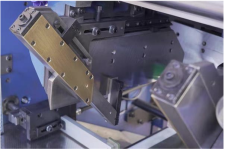
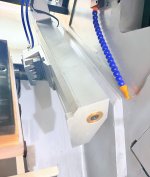
The article discusses a "spine scoring blade" device (also called a "spine relief knife") that addresses this issue. The working principle is:
- Before the head/tail knife descends to cut, a small blade first scores a line along the spine edge (depth 0.1-0.2mm)
- This scoring happens at the exact position where the side knife will cut
- The pre-scoring creates a clean cut line, resulting in smooth, clean edges without bursting or tearing
- It also extends cutting blade life by reducing cutting pressure
The device consists of:
- Scoring blade mounting seat
- Blade
- Blade pressure plate
- Pneumatic cylinder
- Adjustment scale
It's activated through the machine control screen and operates automatically during the cutting cycle.
Results:
According to the article, approximately 80% of commercial printing companies in China have adopted this technology with positive feedback, effectively eliminating the spine bursting problem.
Has anyone here implemented similar spine scoring technology in their bindery operations? Would be interested to hear about your experiences with this quality issue and any solutions you've found effective.
The Problem:
The "bursting head" phenomenon is a persistent defect in book production where the spine edge tears or bursts during the final trimming process. This affects both perfect binding and saddle-stitched products, compromising the appearance quality of finished books.
Root Causes:
The article identifies six main causes:
1. Paper grain direction - When cover paper grain runs perpendicular to the spine, it can help reduce bursting but may cause spine warping
2. Excessive side glue thickness in perfect binding - Improper machine operator settings leading to excessive side glue buildup
3. Worn or improperly adjusted grooving knives - When the grooving knife becomes dull or the gap between knife and shear block is too large, it creates rough, distorted grooves
4. Cutting knife grinding angle - Balance needed between sharpness (smaller angle) and durability (larger angle). Optimal range is typically 19°-25°
5. Environmental humidity - Low humidity, especially in winter, increases cracking. Maintaining ~60% RH and ~20°C temperature helps
6. Loose book signatures - The most common issue, caused by signatures not being properly scored at the fold or not being compressed tightly, leaving air pockets
The Technical Solution:
The article discusses a "spine scoring blade" device (also called a "spine relief knife") that addresses this issue. The working principle is:
- Before the head/tail knife descends to cut, a small blade first scores a line along the spine edge (depth 0.1-0.2mm)
- This scoring happens at the exact position where the side knife will cut
- The pre-scoring creates a clean cut line, resulting in smooth, clean edges without bursting or tearing
- It also extends cutting blade life by reducing cutting pressure
The device consists of:
- Scoring blade mounting seat
- Blade
- Blade pressure plate
- Pneumatic cylinder
- Adjustment scale
It's activated through the machine control screen and operates automatically during the cutting cycle.
Results:
According to the article, approximately 80% of commercial printing companies in China have adopted this technology with positive feedback, effectively eliminating the spine bursting problem.
Has anyone here implemented similar spine scoring technology in their bindery operations? Would be interested to hear about your experiences with this quality issue and any solutions you've found effective.