
What causes speckles?

  • Thread starter Thread starter J
  • Start date Start date

J

Well-known member
Attached is a close-up photo of a press sheet (with a US 1 cent coin for scale). The press sheet has small speckles of the 4 process colors printing in the non-image area. I've seen this from time to time in other press sheets and was wondering what the cause might be.

It is not one of my jobs but it is sheetfed offset.

Click on the image to make it bigger. Is this tinting/toning?

J
 

Attachments

  • Speckles.jpg
    Speckles.jpg
    370.2 KB · Views: 313
It sure looks like it.
Tinting has many causes. here are a few off the top of my head to start the ball rolling.
Rollers settings both ink form or dampener.
Excessive plate/blanket pressure.
Roller or fountain solution temperatures.
Dirty fountain solution
Poorly processed plates
Ink viscosity
weak ink causing to much ink film being carried
poor wash up procedures
ink/water emulsification
Too much wear in ink or water form bearing brackets

I'm sure there will be more folks offering causes.
 
It looks to me as if it is a plate issue. Sometimes when the processor is dirty, they don't scrub the plate well enough to remove the particles of image. Check to make sure the processor is clean with fresh chemicals and see if that doesn't help.
 
It looks to me as if it is a plate issue. Sometimes when the processor is dirty, they don't scrub the plate well enough to remove the particles of image. Check to make sure the processor is clean with fresh chemicals and see if that doesn't help.

What is it about the speckles i the image that suggests this is a plate problem? How would you distinguish between toning and a plate problem? Is it the size of the speckles or amount, or? Do you have a sampe image of toning?

thanks J
 
Heidelberg Guy is probably a pressman ... unless it's an obvious on-press issue, they all rush to blame the plate before considering their own abilities.
 
What is it about the speckles i the image that suggests this is a plate problem? How would you distinguish between toning and a plate problem? Is it the size of the speckles or amount, or? Do you have a sampe image of toning?

thanks J

I have just ran into something identical to this over the past month that was a problem no one could figure out. It's worth it to investigate it anyway.
 
Heidelberg Guy is probably a pressman ... unless it's an obvious on-press issue, they all rush to blame the plate before considering their own abilities.

I am a Pressroom consultant and a ex-Heidelberg Instructor. I'm not blaming anything on anyone, just trying to give options to investigate. The poster above already covered press issues... You must be a pre-press guy, always coming to a conclusion before reading everything... :D
 
I have just ran into something identical to this over the past month that was a problem no one could figure out. It's worth it to investigate it anyway.

Would it be reasonable to say that if the speckles are only in one color then the press is more likely the cause, but if the speckles are in all four colors then it is more likely that the plate is the cause?

best, gordo
 
are you pushing the inks? if you feel you might be pushing the inks a bit you might want to check that your wet side down transfer points are clean. As the press is running up to run speed try stopping the press dead with the E stop button. then go in between units at various points and try pulling the sheets out of the grippers in various stages of print to determine just where the potential mark is begining. the reason i suspect this is because you mentioned that its 4/c process being printed, to make an image that could have, and probably should have been arrived at as a black only image. Ive seen dirty transfer jackets or dirty super blues cause speckles like that particularly in an area of high percentage process builds.
 
Emulsification

Emulsification

Hello fellow Lithographers,

It is my considered opinion, the so called Speckles is the result of printing with

Emulsified Ink, look closely and you will see Snowflaky pattern appearing in the Ink Film

See the JPGs also the PDFs


Regards, Alois
 

Attachments

  • scumming #1090.jpg
    scumming #1090.jpg
    410.9 KB · Views: 323
  • scumming # 2091.jpg
    scumming # 2091.jpg
    387 KB · Views: 296
  • 47.jpg
    47.jpg
    32.3 KB · Views: 320
I agree with Alois, came across this before at my press. We determined that the ink was getting emulsified, we measured the conductivity of the water and determined that the mixer was mixing too much fountain solution so it was too 'hot' and emulsifying the ink. I hope this helps
 
Doesn't look like toning/tinting/scumming.

Looks like emulsification, misting, ink being pushed too hard, or incomplete clean out of the plates.
 
Doesn't look like toning/tinting/scumming.

Looks like emulsification, misting, ink being pushed too hard, or incomplete clean out of the plates.

In my experience, if SIDs are too high for the ink you get misting or tailing that looks something like the attached image. It is always directional.

If this doesn't look like toning/tinting to you - what does toning/tinting look like. How would it look different?

best, gordon p
 

Attachments

  • Tailing.jpg
    Tailing.jpg
    19.6 KB · Views: 296
What I call scumming/toning/tinting is the result of too little fountain solution. The whole sheet gets a tint, or tone, of the offending color - like pulling dry solids.
 
What I call scumming/toning/tinting is the result of too little fountain solution. The whole sheet gets a tint, or tone, of the offending color - like pulling dry solids.

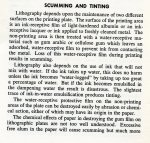
Scumming and toning/tinting do not mean the same thing.

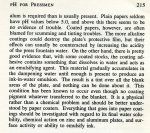
Scumming and catch up occur where ink adheres to the non-image area of the plate, and begins to print. Catch-up is a direct result of insufficient dampening. Increasing the dampening solution slightly usually clears catch-up but has little effect on scumming. Scumming is usually either a plate problem or a weak fountain solution problem.

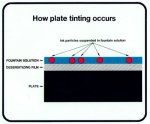
Tinting (also called toning) on the other hand, is caused by contamination of the fountain solution by either ink, or some coloring matter from the ink. Since fountain solution is all over the non image area, any coloration will be likewise.

best, gordon p
 
   
Back
Top