

James44
Member
I originally posted about this 2 years ago
I now have more information and more examples.
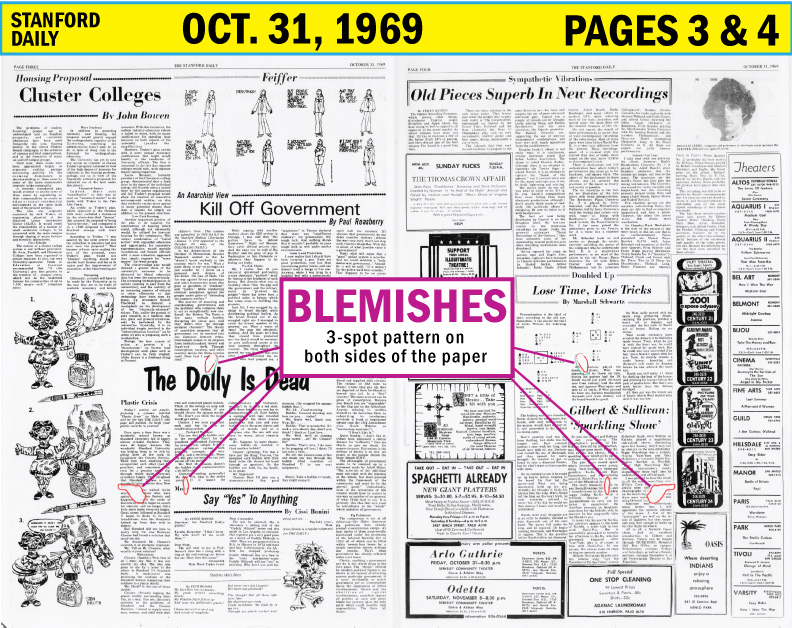
White Spots on the Stanford Daily
It seemed to me that if the spots had any significance, they would be unique. Now I thought I had seen other spots a few times, but I could not remember. There was only one way to find out. So I commenced the arduous task of closely examining all 1969 Stanford Daily issues, again, this time looking for spots.
I started at the October 31 issue and worked forward. The next issue, Monday November 3, had no spots. Tuesday November 4 was also clean.
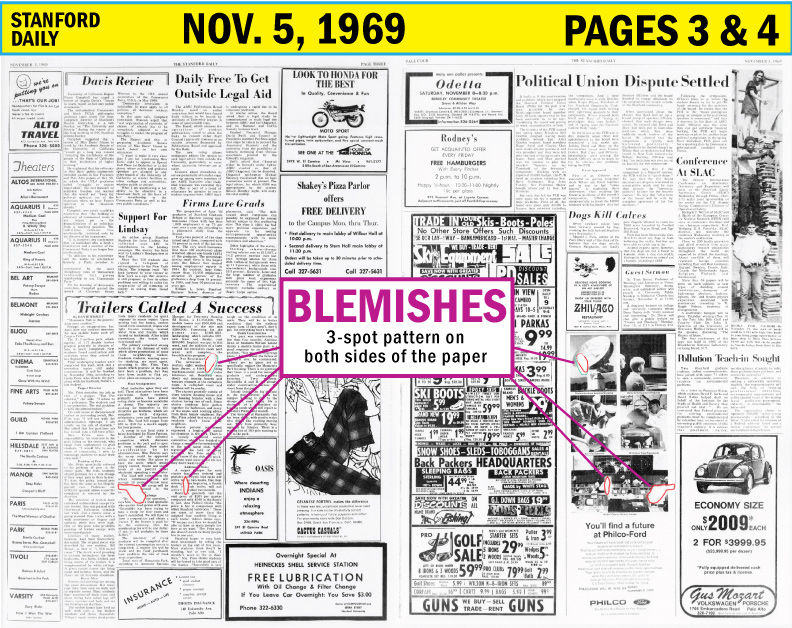
On the Wednesday November 5 issue I also found spots on pages three and four that looked similar to the spots from October 31.
Moving on to the November 6 issue there were minor spots on pages 1 and 2.
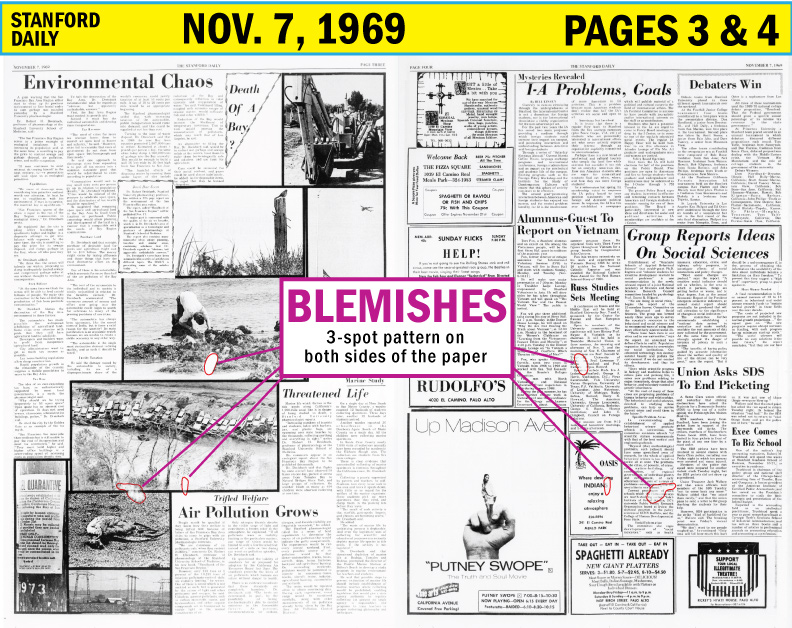
The November 7 issue again had spots on pages one, and then had the similar spots on pages three and four again. It was becoming apparent that spots on the Daily were not unique at all, in fact, they were a fairly regular occurrence. I began to question my conjecture that a solvent had been used. Perhaps it wasn’t that at all, and instead a printing or scanning defect when the archive was made?
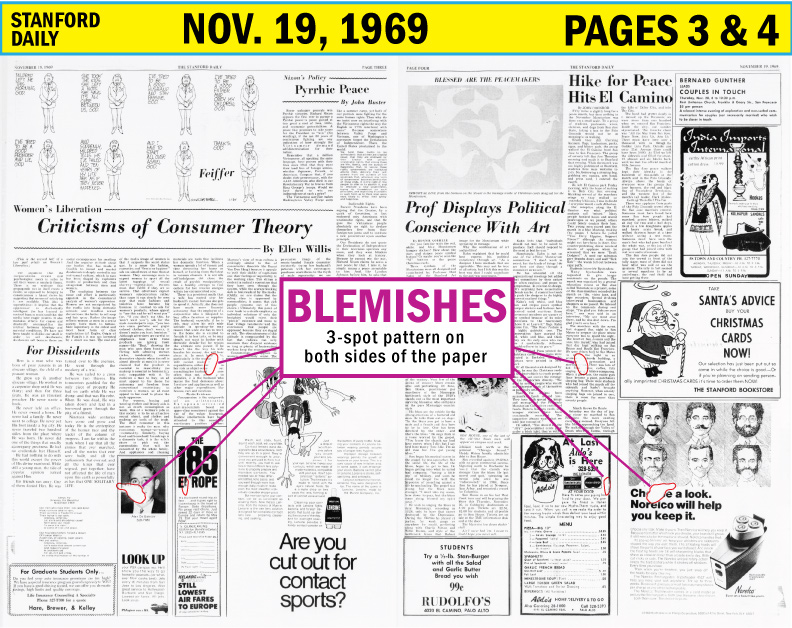
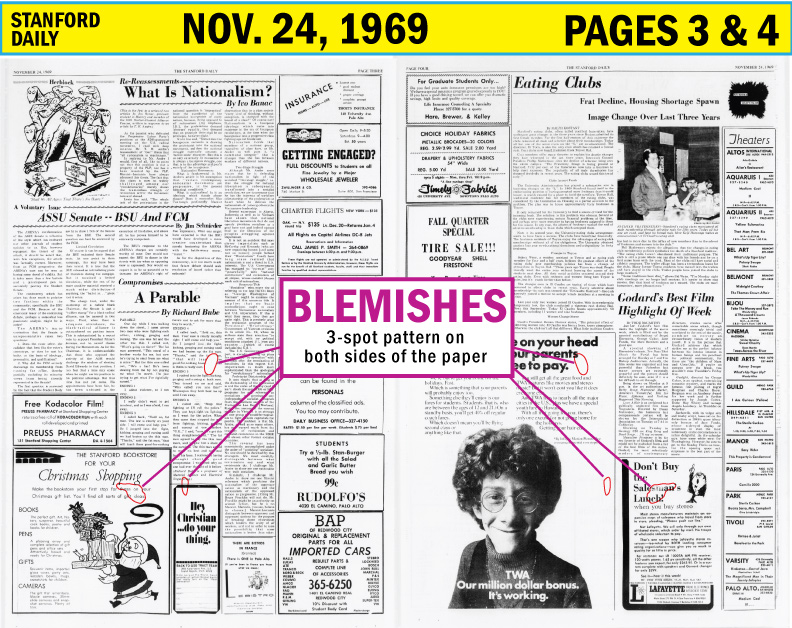
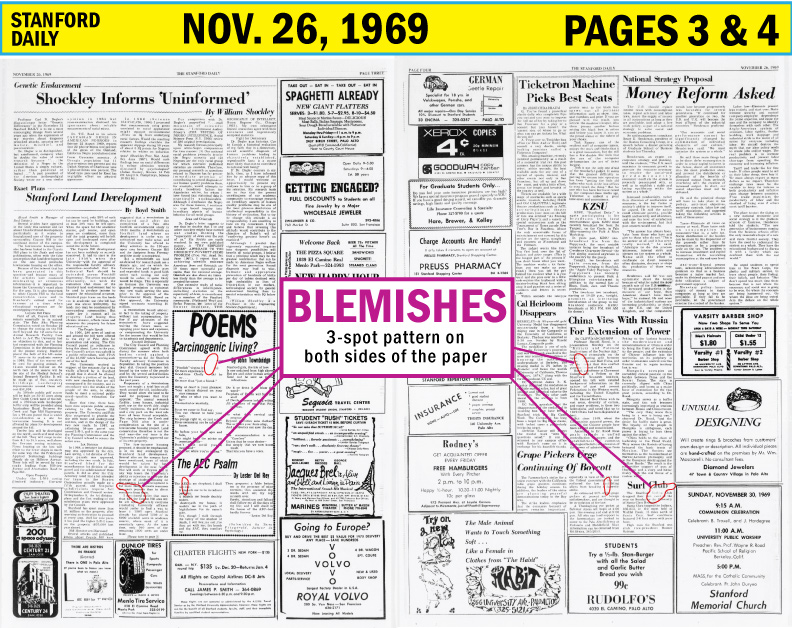
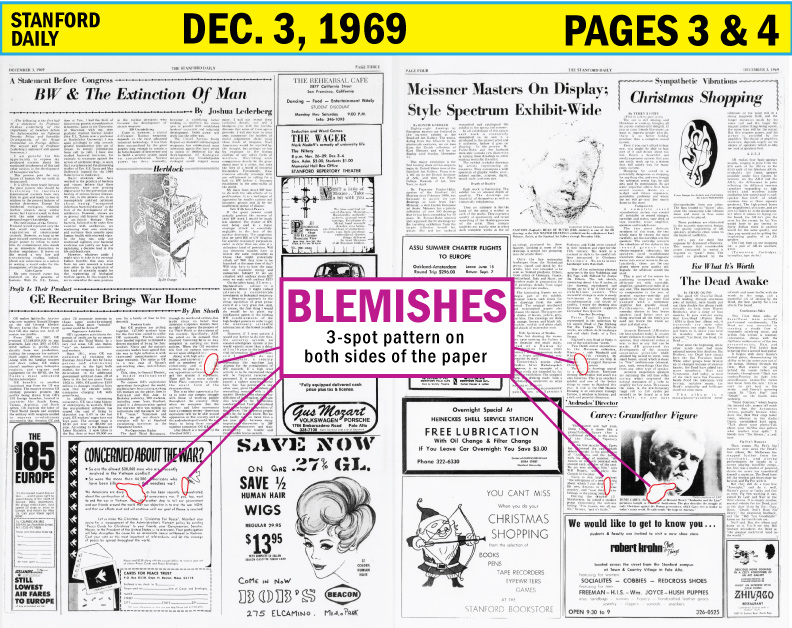
There were no spots for the next five issues. But starting on November 17, I found spots on pages three and four; November 19, pages three and four; November 24, pages three and four; November 26, pages three and four; December 3, pages three and four; and December 5, the last issue of the quarter, on pages five and six.
I looked at the first weeks of issues in January, and there were no spots, so I went back to the October 31 issue, and then worked backwards.
There was a possible spot on the October 30 issue, but it looked like a paste up error on an ad. I marked it as a “maybe.” Then I looked at the October 29, 28, and 27 issues and didn’t see any spots on them. Nor were there any spots in any issue resembling the previous ones going back to September 26, the first issue of the fall 1969 school quarter. There were a couple issues with print degradation, scratches, or letters trailing off with light printing, but there were no spots anywhere near as pronounced as what I had previously found.
I put all this into a new spreadsheet. It was clear that the vast majority of spots occurred on pages three and four, and that almost every time there was a spot, it was always on a Monday, Wednesday, or Friday. There were also unique spots that occurred during this time period, from October 31 to December 5. An examination of the Dailys from the years directly before and after these spots occurred did not uncover any more spots.
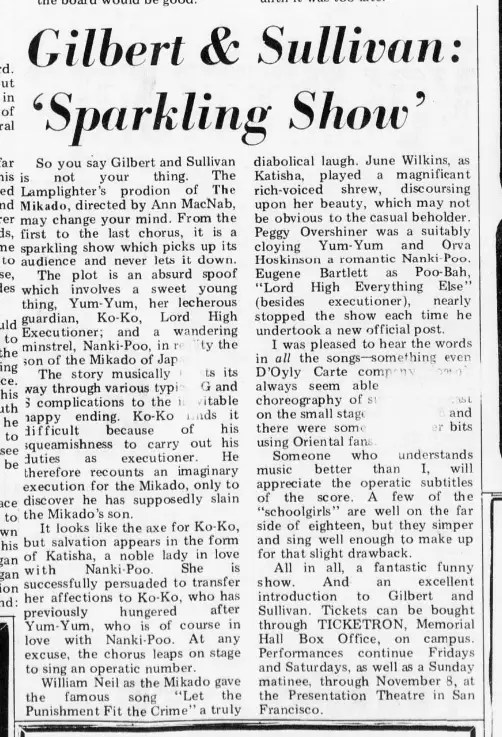
All of this aside, I finally realized what many of you likely already have: These spots in the Daily first show up on October 31. The first incidence of these spots is on the Mikado review.
I noted that many of the spots looked similar. But I wondered, just how similar? I imported all the pages into the Photoshop document that held the October 31 pages. When the pages were aligned, there it was, clearly the three-spot pattern was identical, it only varied by what was printed on the page, and by the density of ink. It could also be hidden if it were in the white space of the page, but it was in the exact same location on multiple pages, on both sides of the paper each and every time.
I confirmed that this exact three-spot pattern occurred eight times, from October 31 to December 5. The pattern appeared on pages three and four, seven out of eight times, with the exception being December 5, the final issue of the quarter, where it appeared on page five and six.
This was not someone pouring a solvent on the paper after it was printed. I tried to imagine what would produce what I was seeing. I conjectured it could be a scanning artifact, but why then would it happen on opposite sides of the same sheet of paper, and why only on a few pages? I honestly couldn’t explain what I was seeing by a scanning defect.
A more sound conjecture was that this was a recurring print defect that had to occur at the printer. I called some people who worked on newspaper presses, including G who ran the local newspaper back in Indiana. I knew they had still printed the paper there in the newspaper offices until the early 20th century. G was a family friend, so I gave him a ring.
Upon my description of the spots, G thought that they were likely caused by a crushed blanket—a blanket being a key element in the printing process. Ink was transferred to the blanket, and from the blanket to the paper. And because both sides of the paper would get printed at the same time, a defect on one side showed up on both. G said these were not really “spots” but “blemishes.”
He explained that crushed blankets usually happened when something jammed in the press, like some misfed paper.
“Could someone intentionally damage the blanket?” I asked.
“Yes, you could just touch it with your hand, wearing gloves or using a rag. More likely you would ding it with a hammer, I suppose. It would be quite easy,” G replied.
“Could you intentionally place the damage over a specific article?” I asked.
“Yes, that would be easily accomplished,” answered G.
“And how would one know where to hit the blanket?” I asked.
“Well, you just look. You can see the entire page on the blanket. It’s mirrored, but pressmen all know how to read backwards and even if you don’t, you can see the articles. You would just ding it right on it,” said G.
“Why would the three-spot pattern only occur every once in a while? Why are some issues printed without the spots?” I asked.
G posited a theory: He explained that printers almost certainly had more than one press, and it was vital to keep those presses running as close to 24/7 as possible. Scheduling your time on press is a big deal in printing, especially in the time-sensitive, deadline-oriented printing of newspapers.
He surmised that the press with the crushed blanket was only used when the others, those without the defect, were busy. If there was a print job that was of higher priority, that would get to be run on the good presses, bumping the student newspaper to the press with the defect. The fact that it was always on Monday, Wednesday, or Friday likely meant that there were other jobs of higher priority on those days.
As for not replacing the damaged blanket, it was a time-consuming task, and you might not replace it, if it wasn’t too bad, until you had a significant break in your schedule.
“Like during a slowdown around Christmas?” I asked.
“Exactly,” replied G.
As for the one issue where the 3-spot pattern occurs on pages five and six, G said that was also easily explained—either there was a different pressman on that day who lined up the pages a different way, or the issue might have been special in some way or had more pages than normal, making it arranged on the cylinder differently. I subsequently discovered that this issue indeed had 14 pages, the largest issue of the year.
So, what I have discovered is that the three-spot defect in the Stanford Daily is first seen on October 31, 1969, and it continued on many, but not all, issues until December 5, 1969. It begins on a review of the SF Lamplighter’s production of Mikado with a spot on each of two columns. The occurrences of the blemishes are explained by a crushed blanket on the printing presses, appearing only on days when scheduling at the printing vendor forced the damaged press to be utilized, and not being fixed until sometime after the school term was out, during the Holiday Season.
So, G says this is absolutely a crushed print blanket. Is there any other explanation for these blemishes?

I now have more information and more examples.
White Spots on the Stanford Daily
It seemed to me that if the spots had any significance, they would be unique. Now I thought I had seen other spots a few times, but I could not remember. There was only one way to find out. So I commenced the arduous task of closely examining all 1969 Stanford Daily issues, again, this time looking for spots.
I started at the October 31 issue and worked forward. The next issue, Monday November 3, had no spots. Tuesday November 4 was also clean.
On the Wednesday November 5 issue I also found spots on pages three and four that looked similar to the spots from October 31.
Moving on to the November 6 issue there were minor spots on pages 1 and 2.
The November 7 issue again had spots on pages one, and then had the similar spots on pages three and four again. It was becoming apparent that spots on the Daily were not unique at all, in fact, they were a fairly regular occurrence. I began to question my conjecture that a solvent had been used. Perhaps it wasn’t that at all, and instead a printing or scanning defect when the archive was made?
There were no spots for the next five issues. But starting on November 17, I found spots on pages three and four; November 19, pages three and four; November 24, pages three and four; November 26, pages three and four; December 3, pages three and four; and December 5, the last issue of the quarter, on pages five and six.
I looked at the first weeks of issues in January, and there were no spots, so I went back to the October 31 issue, and then worked backwards.
There was a possible spot on the October 30 issue, but it looked like a paste up error on an ad. I marked it as a “maybe.” Then I looked at the October 29, 28, and 27 issues and didn’t see any spots on them. Nor were there any spots in any issue resembling the previous ones going back to September 26, the first issue of the fall 1969 school quarter. There were a couple issues with print degradation, scratches, or letters trailing off with light printing, but there were no spots anywhere near as pronounced as what I had previously found.
I put all this into a new spreadsheet. It was clear that the vast majority of spots occurred on pages three and four, and that almost every time there was a spot, it was always on a Monday, Wednesday, or Friday. There were also unique spots that occurred during this time period, from October 31 to December 5. An examination of the Dailys from the years directly before and after these spots occurred did not uncover any more spots.
All of this aside, I finally realized what many of you likely already have: These spots in the Daily first show up on October 31. The first incidence of these spots is on the Mikado review.
I noted that many of the spots looked similar. But I wondered, just how similar? I imported all the pages into the Photoshop document that held the October 31 pages. When the pages were aligned, there it was, clearly the three-spot pattern was identical, it only varied by what was printed on the page, and by the density of ink. It could also be hidden if it were in the white space of the page, but it was in the exact same location on multiple pages, on both sides of the paper each and every time.
I confirmed that this exact three-spot pattern occurred eight times, from October 31 to December 5. The pattern appeared on pages three and four, seven out of eight times, with the exception being December 5, the final issue of the quarter, where it appeared on page five and six.
This was not someone pouring a solvent on the paper after it was printed. I tried to imagine what would produce what I was seeing. I conjectured it could be a scanning artifact, but why then would it happen on opposite sides of the same sheet of paper, and why only on a few pages? I honestly couldn’t explain what I was seeing by a scanning defect.
A more sound conjecture was that this was a recurring print defect that had to occur at the printer. I called some people who worked on newspaper presses, including G who ran the local newspaper back in Indiana. I knew they had still printed the paper there in the newspaper offices until the early 20th century. G was a family friend, so I gave him a ring.
Upon my description of the spots, G thought that they were likely caused by a crushed blanket—a blanket being a key element in the printing process. Ink was transferred to the blanket, and from the blanket to the paper. And because both sides of the paper would get printed at the same time, a defect on one side showed up on both. G said these were not really “spots” but “blemishes.”
He explained that crushed blankets usually happened when something jammed in the press, like some misfed paper.
“Could someone intentionally damage the blanket?” I asked.
“Yes, you could just touch it with your hand, wearing gloves or using a rag. More likely you would ding it with a hammer, I suppose. It would be quite easy,” G replied.
“Could you intentionally place the damage over a specific article?” I asked.
“Yes, that would be easily accomplished,” answered G.
“And how would one know where to hit the blanket?” I asked.
“Well, you just look. You can see the entire page on the blanket. It’s mirrored, but pressmen all know how to read backwards and even if you don’t, you can see the articles. You would just ding it right on it,” said G.
“Why would the three-spot pattern only occur every once in a while? Why are some issues printed without the spots?” I asked.
G posited a theory: He explained that printers almost certainly had more than one press, and it was vital to keep those presses running as close to 24/7 as possible. Scheduling your time on press is a big deal in printing, especially in the time-sensitive, deadline-oriented printing of newspapers.
He surmised that the press with the crushed blanket was only used when the others, those without the defect, were busy. If there was a print job that was of higher priority, that would get to be run on the good presses, bumping the student newspaper to the press with the defect. The fact that it was always on Monday, Wednesday, or Friday likely meant that there were other jobs of higher priority on those days.
As for not replacing the damaged blanket, it was a time-consuming task, and you might not replace it, if it wasn’t too bad, until you had a significant break in your schedule.
“Like during a slowdown around Christmas?” I asked.
“Exactly,” replied G.
As for the one issue where the 3-spot pattern occurs on pages five and six, G said that was also easily explained—either there was a different pressman on that day who lined up the pages a different way, or the issue might have been special in some way or had more pages than normal, making it arranged on the cylinder differently. I subsequently discovered that this issue indeed had 14 pages, the largest issue of the year.
So, what I have discovered is that the three-spot defect in the Stanford Daily is first seen on October 31, 1969, and it continued on many, but not all, issues until December 5, 1969. It begins on a review of the SF Lamplighter’s production of Mikado with a spot on each of two columns. The occurrences of the blemishes are explained by a crushed blanket on the printing presses, appearing only on days when scheduling at the printing vendor forced the damaged press to be utilized, and not being fixed until sometime after the school term was out, during the Holiday Season.
So, G says this is absolutely a crushed print blanket. Is there any other explanation for these blemishes?