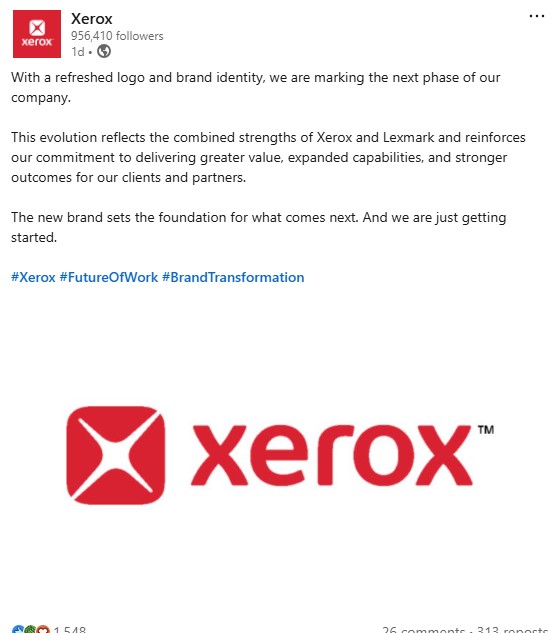
Xerox announces new logo

jwheeler

Well-known member
Well, this should fix all of their problems! 😜 Here's a link to the original post on LinkedIn if you want to see the comments.
Xerox announces new logo.jpg
 
After 40+ years of being a Xerox customer almost exclusively, I'm having a Ricoh machine put in next week. Service techs were never a problem. Corporate policies and lack of product offerings made me look elsewhere. I recently started getting phone calls from their A/R people 2 weeks before my invoices were due. The new logo is nice, but doesn't change my mind, unfortunately.
 
After 40+ years of being a Xerox customer almost exclusively, I'm having a Ricoh machine put in next week. Service techs were never a problem. Corporate policies and lack of product offerings made me look elsewhere. I recently started getting phone calls from their A/R people 2 weeks before my invoices were due. The new logo is nice, but doesn't change my mind, unfortunately.
Congrats! Which Ricoh did you install?
 
It's the symbolic "erasing of the old" and "starting of the new".

I hope it works out for them. At one time, they were the best. Top of the heap. At that time we were an all Xerox shop. Good sales people, top notch technicians, and on site technical training and support like nothing I'd ever seen.

And, if the product they installed did not live up to the Customer Expectation Document, they would replace the machine or let you out of the deal. No questions asked.

Then, some bean counters up at corporate got the big idea to start outsourcing everything. All their great sales people were laid off as well as their technicians. Those functions were outsourced to independent dealers.

At that point, Xerox lost all control over sales and service as they were no longer employees of Xerox.

They've been in a steady spiral down the drain ever since. I hope to see them someday rebuild what they've lost.

 
It's the symbolic "erasing of the old" and "starting of the new".

I hope it works out for them. At one time, they were the best. Top of the heap. At that time we were an all Xerox shop. Good sales people, top notch technicians, and on site technical training and support like nothing I'd ever seen.

And, if the product they installed did not live up to the Customer Expectation Document, they would replace the machine or let you out of the deal. No questions asked.

Then, some bean counters up at corporate got the big idea to start outsourcing everything. All their great sales people were laid off as well as their technicians. Those functions were outsourced to independent dealers.

At that point, Xerox lost all control over sales and service as they were no longer employees of Xerox.

They've been in a steady spiral down the drain ever since. I hope to see them someday rebuild what they've lost.

Agreed. It’s been sad to see their decline recently. I’m far newer to the industry than you, entering it in 2014ish but when we got our Xerox 1000i in 2015 it seemed like Xerox was peaking and we didn’t know it. Our sales guys were awesome, bent over backwards, our techs were all in and amazing. Hell I remember getting a call one day from a regional service manager asking if we were busy that day. I said no it’s slow, what do ya need? He said he has a customer who’s 1000i fiery crashed and reasons too complicated for me to understand they needed a working fiery to clone and I was the closest. I said come on down. Tech drove 2+ hours and spent all day and night extracting from our machine whatever he needed. Closing time came and I tossed him a key and said just lock it up when ya head out. He ended up leaving around 11pm and went to the other customers place to get started. Doubt you’d see that anymore from Xerox. Our techs were great up until we left but we saw the writing on the wall. Our main tech took early retirement and was telling me how they’d have to override service orders because they’d send them to a tech 2+ hours from us when he lived 45 mins away and was our main service guy. When he told me he was leaving it was like a sign we should too.
 
Agreed. It’s been sad to see their decline recently. I’m far newer to the industry than you, entering it in 2014ish but when we got our Xerox 1000i in 2015 it seemed like Xerox was peaking and we didn’t know it. Our sales guys were awesome, bent over backwards, our techs were all in and amazing. Hell I remember getting a call one day from a regional service manager asking if we were busy that day. I said no it’s slow, what do ya need? He said he has a customer who’s 1000i fiery crashed and reasons too complicated for me to understand they needed a working fiery to clone and I was the closest. I said come on down. Tech drove 2+ hours and spent all day and night extracting from our machine whatever he needed. Closing time came and I tossed him a key and said just lock it up when ya head out. He ended up leaving around 11pm and went to the other customers place to get started. Doubt you’d see that anymore from Xerox. Our techs were great up until we left but we saw the writing on the wall. Our main tech took early retirement and was telling me how they’d have to override service orders because they’d send them to a tech 2+ hours from us when he lived 45 mins away and was our main service guy. When he told me he was leaving it was like a sign we should too.
Same here Xerox was great when I got into the industry but they tanked after Covid and never really seem to have recovered.
 
Same here Xerox was great when I got into the industry but they tanked after Covid and never really seem to have recovered.
I would say it was the failed transaction agreement with Fuji that is more to blame, just happened to coincide with the timing of Covid.
That failure would have been hampering machine developement in the years up to and after that breakdown.
 
I would say it was the failed transaction agreement with Fuji that is more to blame, just happened to coincide with the timing of Covid.
That failure would have been hampering machine developement in the years up to and after that breakdown.
I also wonder about the Fuji fire factory. The time it took to recover after the fire and retool machines and things. How much did fuji have to "solve" or "reinvent" when they rebuilt the factory because there's an awful lot of institutional knowledge that disappears over time that is hard to recreate vs. maintaining the old stuff.
 
Someone correct me if I'm wrong, but, I'm pretty sure that the only digital production press that Xerox ever produced was the iGen series.

All the rest were Fuji boxes with a Xerox logo.
 
Someone correct me if I'm wrong, but, I'm pretty sure that the only digital production press that Xerox ever produced was the iGen series.

All the rest were Fuji boxes with a Xerox logo.
ChatGPT says:

The key standalone engines engineered and manufactured directly by Xerox besides the iGen series include:
  • Nuvera Series: High-speed, monochrome production printers known for sharp image quality and MICR capabilities, also manufactured at the Rochester plants.
  • DocuTech Series: The pioneering family of high-speed, heavy-duty publishing systems that dominated the 1990s and 2000s before shifting to the iGen line.
  • DocuPrint: Early internally-developed monochrome and color laser network printers.
  • Xerox 914: The historic 1959 machine that introduced the first automated plain-paper copying process.
 
Thanks JW. I wasn't totally correct, but, that's just about what I figured..

We really didn't have a need for straight B&W, so, we didn't have any use for the Nuvera.

We started way back with the Xerox DocuColor 5000, 7000, 8000, 8080 none of which were actually manufactured by Xerox. The DC 8000 and 8080 were actually sold to us by our local Fuji salesman even though Xerox technicians maintained it.

We never went the iGen route, even though they were pushing it pretty hard.

From the DC 8080 we went to the Versant 2100, 3100, etc. Also not made by Xerox.

About a year after we installed the V2100, we were visited by a group of engineers from Fuji Japan only one of which spoke broken English. They were looking for ideas and suggestions on how to make the product better from a production standpoint.
 
Last edited:
It's certainly interesting to see the evolution (or lack thereof) of the machines/tech over time.
One trend I'm starting to see is that instead of fixing the "mechanics" of the machines and how they function, there seems to be a big push to try to solve everything with software. I understand the main driver is that you can't replace the boxes already "out" in the wild, you can update the software.

The problems with that is:
  1. You have people who have never actually run the equipment trying to fix mechanical issues with software.
  2. There's no real push to solve problems mechanically, or build a better mousetrap.
  3. Nobody is making any real efforts to solve actual problems, they just say "well, it's a known problem and there's no solutions".
For example:
  • Canon's v900s - For registration I recently learned that:
    • They use a sensor just before the fuser to detect the edge of the operator side of the paper (about every 100 sheets).
    • That sensor then shifts (using software) the placement of the image for the next 100ish sheets.
  • Problems:
    • The sensor gets covered in dust very quickly (wiping this sensor down regularly solved so many issues we were having).
    • Registration shifts a lot during the run if the sensor is off (1-2mm drift from what I'm seeing).
    • Paper is rarely exactly the right size (mm to inches varies depending on manufacturer). 12.05in vs. 17.95in
    • Running images based on operator side can be bad for some items. IE. Brochures printed 2-up if it's off by 1-2mm on the top edge vs. bottom edge.
    • Prints are rarely centered on the sheet.
  • It feels like this would be an area that would be better solved mechanically than software but maybe I'm just wrong? Shrug.
 
There's no real push to solve problems mechanically
To give credit where it's due, I do know Konica Minolta makes great efforts to take feedback from the techs and users in the field to upgrade their newer models. For instance, their disastrous C8000 series attempted something new for them by using a dual fuser system. But they scrapped the dual-fuser system and had great success with the completely modified C1085/C1100 series. With that series, there was an issue with waste toner building up above the paper path, and there would be random toner splotches. They fixed this by developing a 'cyclone vacuum/filter' system on the C6085/C6100 series. We have the C6085 and the machine is a tank.

I know of other mechanical fixes they made on their monochrome series such as components that often failed on the 1052/1250 series, they replaced with better/stronger components. Many of these they were able to do field upgrades on existing models and they became standard on the 6136 series. For our C7090/C7100 series, there were numerous issues in the beginning. They didn't tell us "well, it's a known problem and there's no solutions". They sent multiple techs, and even brought in more knowledgeable regional techs to make fixes until official fixes were sent out. They then came and replaced physical components with upgrades and made many firmware/software updates. The press isn't perfect now, but it's far better than it was. They have made those changes standard on the new C7100e series.

I personally don't have much experience with the other brands as a user (other than Xerox back in the day of the Doc 12 and briefly with the DocuColor 250 maybe 15+ years ago) so I don't know if they do the same things.

But as for the "better mousetrap"...it does seem that most of the big names are investing a lot into inkjet technology which seems to be where the industry is headed. Those systems are getting faster, offering better quality, and able to print on a wider range of media than initial offerings.
 
To give credit where it's due, I do know Konica Minolta makes great efforts to take feedback from the techs and users in the field to upgrade their newer models.

Many of these they were able to do field upgrades on existing models and they became standard on the 6136 series. For our C7090/C7100 series, there were numerous issues in the beginning. They didn't tell us "well, it's a known problem and there's no solutions".
That's super great to hear that there are still some innovators pushing the market ahead.
But as for the "better mousetrap"...it does seem that most of the big names are investing a lot into inkjet technology which seems to be where the industry is headed. Those systems are getting faster, offering better quality, and able to print on a wider range of media than initial offerings.
I've been wondering about why there is such a big push towards inkjet. It's it just that ink is cheaper. I never liked the inkjet envelope printer we had, it always felt visually washed out compared to what I saw with our toner boxes. I've also seen some offset prints (higher volumes), it doesn't always feel like it looks better to me. If you have to use a lot of ink to get a decent saturation then is it better? Having said that, there is a plus to inkjet when it comes to being able to write on the prints afterwards (for books and invitations etc.)
 
I've been wondering about why there is such a big push towards inkjet.
I think that, from the beginning, the "Holy Grail", was to develop a digital printer that was every bit as good as offset. That's nearly impossible with a toner based machine so they naturally gravitated toward ink, just like offset. They still have a long way to go.........
 
I never liked the inkjet envelope printer we had, it always felt visually washed out compared to what I saw with our toner boxes
Those aren’t really the types of printers I'm referring to. Any system like the Riso ComColor, Kyocera Taskalfa Pro 15000c, or the iJet envelope printers all use low-quality, high speed memjet-type print heads with aqueous dye/pigment inks. The quality is only good for transactional forms, envelopes, and school classroom handouts. They aren't meant to compete with the quality of toner and offset presses.

I'm referring to systems like the Konica Minolta AccurioJet 3000, the Ricoh Pro Z75, and the Canon VarioPress iV7. These all produce very high quality prints that can compete with offset, and can print on a wider range of substrates. They are all in the B2 size. However, Canon recently announced the varioPrintiX1700 which handles smaller sheets (14.33" x 26").
 
Last edited:
   
Back
Top